Do you own a DigiTech Lyra pedal? Visit the Lyra Registry Project HERE
A Note from Ron:
The main goal of AmericasPedals.net is to help preserve the history of DOD and DigiTech effects. Every year, original literature becomes harder to find, websites
vanish, photographs are lost, and firsthand knowledge fades away.
This page reflects my ongoing research into the DigiTech Lyra. As new information, photographs, documentation, and firsthand observations come to light, I will
continue updating it so the story becomes more complete over time.
If you have something that can help document the history of the Lyra, or any other DOD or DigiTech product, I would genuinely love to hear from you.
The DigiTech Lyra isn't just rare. It's one of the least-documented pedals DigiTech ever released. Only 1,000 were produced, and despite being tied to the
ambitious Eternal Descent project, it quietly disappeared before most guitar players even knew it existed. That's exactly the kind of pedal I love digging into.
When DigiTech introduced the Lyra in 2011, it didn't fit neatly into any existing category. It was a limited-edition collaboration connected to Eternal Descent, the
comic book and music project created by Llexi Leon, with legendary producer Eddie Kramer helping shape its sounds. While it was never officially part of DigiTech's
Artist Series, it clearly shared the same signature-tone philosophy.
Its limited production immediately put the Lyra in rare company. A lot of DigiTech pedals were made by the truckload. The Lyra was not. It came and
went quietly, and because so few players ever owned one, it never built the kind of large online footprint that pedals like the Bad Monkey, Grunge, Space Station,
or even the Artist Series models eventually developed.
That is what drew me to it.
The more I looked into the Lyra, the more I realized almost everybody was repeating the same handful of facts. There were press releases, a few retailer descriptions,
some old stock photos, a small amount of collector discussion, and not much else. For a pedal this unusual, it deserved a closer look.
From a collector's standpoint, the Lyra is fascinating because it feels like a bridge between two different DigiTech worlds. On one side, you have the Artist Series
pedals, where DigiTech built dedicated stompboxes around recognizable signature sounds. On the other side, you have the RP500 and RP1000 era, when DigiTech was packing
serious amp modeling, effects, switching, and recording tools into powerful floor processors. The Lyra seems to live right in the middle of those ideas: seven
signature tones from the Eternal Descent project, placed into a compact stompbox using the same general enclosure family as pedals like the Bad Monkey, Hot Head,
Screamin' Blues, and Grunge.
This first version of the page is meant to give the Lyra a proper home on AmericasPedals.net. As more information is verified, and as more photographs and firsthand
details become available, this page will continue to grow.
Okay, lets begin our Eternal Descent =)
Controls:
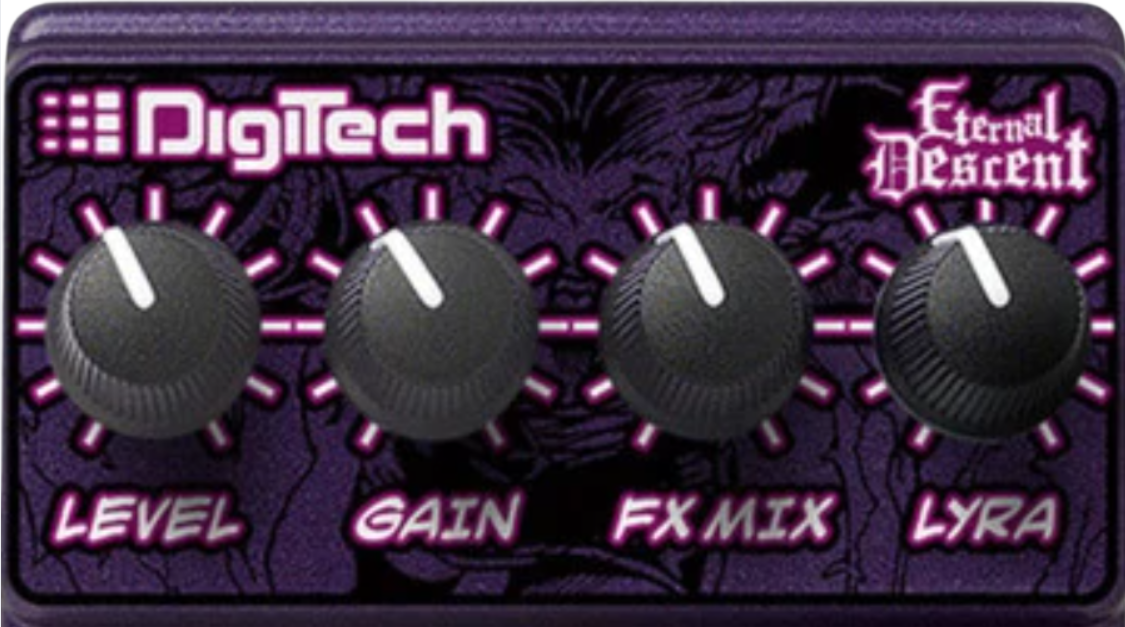
Level: Controls the overall output volume of the pedal. This is where you balance the Lyra against your clean amp, your existing pedalboard, or whatever drive sound you already have dialed in. With a pedal like this, Level matters because some presets can feel bigger or more processed than others.
Gain: Adjusts the amount of drive or intensity in the selected Lyra sound. Since the Lyra is preset-based, this is not the same as turning up the gain on a normal analog distortion pedal. Think of it more as a way to push each model harder or pull it back a little so it sits better in your rig.
FX Mix: Blends in the effect portion of the selected preset. This may be the most important control on the whole pedal. Turned up high, the Lyra can get dramatic and very produced. Backed down, it can add just enough of the Eternal Descent flavor without taking over your entire sound.
Lyra Selector: Selects one of the seven signature sounds. These are not individual stompbox effects in the traditional sense. Each position is a complete DigiTech-style preset built around a specific tone from the Eternal Descent world.
DigiTech® Lyra pedal demonstration with Eternal Descent creator, Llexi Leon below (5 minutes, 32 seconds)
Model 1: Crystal Cascade
Sound Profile: A shimmering clean tone laden with repeats.
Core Effects: Heavy shimmer and delay.
Official Manual Quote: "Memories flooding back, moments lost in time, echo in eternity."
Model 2: The Morass
Sound Profile: An eerie, overdriven rhythm and lead sound.
Core Effects: A touch of dirt/gain paired with a swirling phase shifter.
Official Manual Quote: "Distant melodies come bubbling from the black mire."
Model 3: Ethereal Entity
Sound Profile: A highly saturated, haunting lead tone.
Core Effects: Slow attack envelope and a heavy reverse delay.
Official Manual Quote: "The voices of the damned are calling."
Model 4: Divine Lead
Sound Profile: A soaring, majestic rock lead tone.
Core Effects: High gain coupled with a distinct pitch-shifted octave effect.
Official Manual Quote: "An aria of the angels."
Model 5: Lyra's Lightning
Sound Profile: A bright, super-charged modern high-gain lead.
Core Effects: Heavy distortion tailored for fast tracking and explicit delay repeats.
Official Manual Quote: "Lyra's signature shred attack."
Model 6: Dark Blues
Sound Profile: A smooth, classic, vintage-voiced crunch.
Official Manual Quote: "On tour with Constellation 9."
Model 7: Crushing Chaos
Sound Profile: An aggressive, chaotic, and heavy modern wall of sound.
Core Effects: Extreme high-gain distortion layered over a sweeping phase shifter.
Official Manual Quote: "Machinations of a madman."
Footswitch: Turns the effect on and off. Simple enough, but with a pedal this collectible, always check that the switch works cleanly before buying. A mint-looking Lyra is wonderful, but it still needs to function like a pedal.
List price: $199.99 (Verified via Digitech May 31, 2011 press release)
Street price: $149.99
Closeout pricing: This one needs further research but here's what I'm seeing. The Lyra started shipping end of May, 2011. By the end of 2011, all 1000 units
had been sold. This created a unique setting where the Lyra did not have time to be discounted before all inventory was sold out. There are reports of retailers selling
their few remaining Lyra pedals for $130 but that needs verifying.
Technical info:
Power:
Uses a DigiTech PS200R included with the pedal when originally sold.
No battery operation.
Because this is a DSP-based DigiTech pedal, always verify the correct power supply before plugging it in.
Specifications:
Effect Type: Preset-based digital multi-effects pedal.
Technology: DigiTech DSP-based effects and modeling technology.
Enclosure: Compact DigiTech metal stompbox enclosure, similar in general form to the D-Series family such as Bad Monkey, Hot Head, Screamin' Blues, and Grunge.
Finish: Custom Eternal Descent fantasy-themed artwork with purple Lyra graphics.
Dimensions:
Width: 3.13 inches (79.5 mm)
Length / Depth: 4.94 inches (125.5 mm)
Height: 2.13 inches (54.1 mm)
Weight: 0.75 lbs (0.34 kg)
Component Variations: None
Notable IC chip: The Lyra is a digital DSP-based pedal, not a collection of separate analog circuits packed into one enclosure.
Component-side circuitboard image: (Coming soon)
Heritage: While the Lyra was never officially marketed as part of DigiTech's Artist Series, I would describe it as the spiritual successor to the Artist Series rather than a sixth member of the family.
For instant Eternal Descent flavor: This is the obvious use. Pick one of the seven Lyra positions, set the Level to match your amp, and use the Gain and FX Mix controls to decide how much of the preset you want in your sound.
As a special texture pedal: The Lyra is not really trying to be a normal everyday distortion box. It makes more sense when you treat it like a color box that brings in a specific mood, atmosphere, or produced sound when the song calls for something different.
In front of an existing rig: One practical way to use the Lyra is to start with a guitar and amp tone you already like, then bring the FX Mix in gradually. That lets the pedal add character without overwhelming everything else on the board.
For recording ideas: This is where preset-based pedals can be a lot of fun. Instead of spending thirty minutes building a sound from scratch, the Lyra gives you seven finished starting points. Some may not be what you expected, but they can push a song idea in a direction you would not have gone on your own.
For collectors who still play their pedals: A lot of rare pedals end up sitting in boxes. I get it. But the Lyra was built to be heard, and part of understanding it is plugging it in and figuring out what DigiTech and Llexi Leon were trying to capture.
Suggested starting settings:
Balanced starting point: Set Level to match your bypassed signal, Gain at noon, FX Mix at noon, then rotate through the seven Lyra positions. This gives you a fair first impression before you start chasing extremes.
Subtle texture: Keep Gain around 10 to 11 o'clock and bring FX Mix down low. This is a good way to add the Lyra's character without making it sound like the pedal has taken over the entire rig.
Full preset experience: Put Gain and FX Mix around noon or slightly above, then adjust Level to taste. If you want to hear the pedal more like a self-contained DigiTech preset machine, this is where I would start.
Heavier rhythm experiment: Choose one of the more aggressive Lyra positions, set Gain around 1 to 2 o'clock, keep FX Mix moderate, and listen for where the low end stays tight. Too much effect blend can get bigger than the riff needs.
Ambient or cinematic texture: Choose one of the more spacious presets, keep the Gain lower, and slowly bring the FX Mix up until the atmosphere blooms without washing out the pick attack.
Recording layer: Track your normal guitar part first, then double it with the Lyra mixed in lower. Sometimes the best use for a pedal like this is not front and center, but tucked behind the main sound where it adds movement and personality.
Collector notes:
The Lyra was limited to 1,000 units, which makes it one of the scarcer DigiTech production pedals collectors are likely to encounter.
Complete examples are far more interesting than bare pedals. The original box, manual, power supply, inserts, and clean packaging all matter with a limited-edition piece like this.
The custom artwork is a major part of the pedal's identity. Check the top face, side edges, bottom plate, knobs, and footswitch area carefully. A mint top with scratched sides is still not the same as a truly clean example.
Because the pedal is numbered, always photograph and document the number when possible. Over time, those numbers may help establish production patterns, surviving examples, and possible packaging variations.
This is one of those pedals that many DigiTech fans still do not know exists. That can make pricing unpredictable. Sometimes rarity pushes prices up. Other times, obscurity keeps a rare pedal under the radar until collectors start paying attention.
Seller photos matter. Since stock images have circulated for years, actual photos of the exact pedal, box, manual, bottom label, and included accessories are much more useful than a recycled promotional picture.
Known quirks and tips:
The Lyra is preset-based, so do not expect the same level of tweakability you would get from a large multi-effects unit or from individual pedals chained together.
The FX Mix control is your friend. If the pedal feels too dramatic, back the mix down before judging the sound. A little Lyra can go a long way.
If you are trying to use it as a normal distortion pedal, you may miss the point. It works better when you treat it as a finished tone machine tied to a specific creative project.
Because the Lyra appears to have roots in the RP1000 era, some players discuss it as if it contains selected RP1000-style signature presets in a stompbox format. That connection is a major research lead, but I am still treating the exact details as something that needs further verification.
The limited production number makes condition and completeness especially important. A clean pedal is good. A clean pedal with the original box, manual, and correct power supply is much better.
Do not rely on generic adapter assumptions. Before powering any Lyra, verify the exact requirements from the pedal labeling, manual, or original power supply.
Ongoing research: (Will update as more info is verified)
Research suggests that there were two more pedals in the works for the Eternal Descent "series."
While DigiTech never published a lot of technical datasheets for the unreleased sequels, the concepts for the other two pedals are highly detailed through the lore of
the Eternal Descent comic universe and simultaneous product rollouts from the franchise.
Why The Trilogy Theory Holds Water
The following points about the pedal names, marketing context, and the structural symmetry of the Eternal Descent universe are the strongest pieces of evidence that this was
supposed to happen. Let's take a closer look.
The "Lyra" Naming Distinction. Calling the pedal "Lyra" instead of the "Eternal Descent" pedal is the ultimate smoking gun from a product management perspective.
In traditional manufacturing, you do not use a highly specific character name for a solo crossover product unless you are carving out room for an expansive line.
The Harman Restructuring Context. The timeline of Harman's internal shift around 2011 is spot-on. This was a chaotic transition era for DigiTech. Their focus at
the time was streamlining operations and cutting costs. This left niche, artist-licensed DSP projects on the chopping block.
The ESP Parallel. Brands coordinate cross-promotional licensing packages years in advance. If ESP Japan had the green light to build the full trio (Lyra, Sirian,
Loki) guitars for the April 2011 launch, it is highly probable that DigiTech's initial plans mirrored that three-part roll-out.
Here is the information I have been able to gather do far. (Remember, ALL of this still needs proven documentation or comment from people who were actually there)
1) The "Good Guy" (Heroic) Pedal: Sirian
The Character: Sirian, a fallen angel character who serves as a primary heroic figure and master guitarist in the comic lore.
The Planned Visuals: It was slated to feature custom artwork of Sirian with his signature angelic wings, likely using a metallic silver or stark white aesthetic to contrast with Lyra’s deep purple finish.
The Intended Tones: While the Lyra pedal focused heavily on a balance of eerie modulation, slow attacks, and heavy rhythm tracking, the Sirian pedal was conceptualized around virtuosic, soaring lead tones. It was meant to emulate high-end Marshall Plexi or Boutique high-gain lead channels, emphasizing pristine note definition, octave-up tracking (the "angelic aria" effect), and bright, fluid delays tailored for rapid shredding.
This is an AI render of what the Sirian pedal could have looked like
All artwork and pedal design copyrights remain with DigiTech and Llexi Leon
2) The "Bad Guy" (Villain) Pedal: Loki
The Character: Named after Loki, a twisted, chaotic demon lord who serves as one of the comic’s primary antagonists.
The Planned Visuals: This stompbox was meant to sport a menacing, hellish aesthetic, heavily utilizing dark reds, blacks, and aggressive, demonic comic art of Loki himself.
The Intended Tones: The Loki pedal was envisioned as an unhinged, ultra-high-gain machine designed for extreme metal and industrial crunch. The voicing would have focused on crushing, low-end rhythm distortion, aggressive pitch-shifting, and extreme flanging or phase-shifting effects. It was meant to capture the sound of "Machinations of a Madman" with dark, heavily compressed, and dense enough for down-tuned death metal or industrial riffs.
This is an AI render of what the Loki pedal could have looked like
All artwork and pedal design copyrights remain with DigiTech and Llexi Leon
Research will continue
This is a COOL story that I will be continually researching and documenting. As new information is uncovered, I will update the page. If you know anything about this
project, please contact me!