Making it's debut at the 2005 Winter NAMM show, the DigiTech Eric Clapton Crossroads is one of the big ones from the DigiTech Artist Series. This pedal was DigiTech taking its Production Modeling™ idea and aiming it straight at one of the most recognizable guitar players to ever plug into an amp. This was not just another overdrive box with a famous name printed on it. DigiTech worked directly with Eric, and his longtime guitar tech Lee Dickson, to build a pedal around seven specific Clapton sounds from different points in his career.
To me, what makes this pedal interesting is DigiTech's scope and vision for it. It's a time machine. Each model represents a different stop along Clapton's musical journey, giving players access to sounds inspired by everything from Cream and Derek and the Dominos to his later solo work. Some of the models are more convincing than others, and guitar players have been debating them since the pedal was released. Personally, I think that's part of the Crossroads' mystique. The pedals everybody agrees on tend to be forgotten. The pedals players are still talking about twenty years later usually have a story worth telling.
Now, let's dive in =)
Controls:
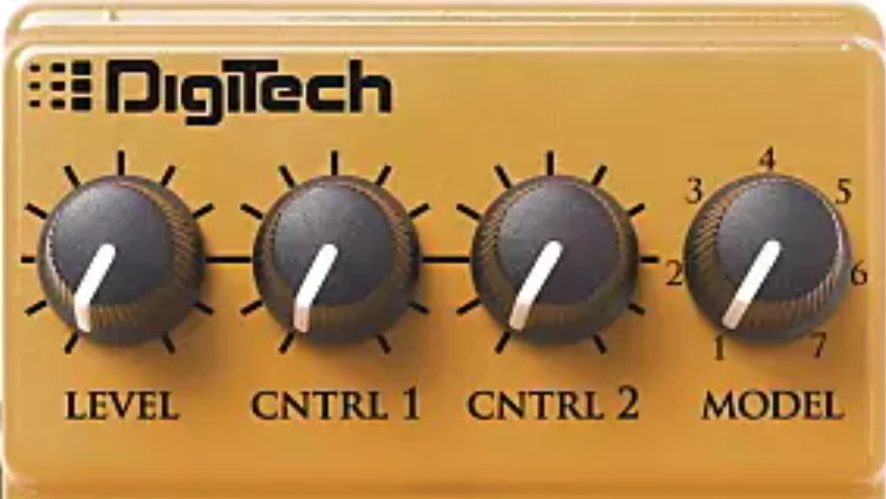
Unlike a traditional overdrive pedal where every knob performs the same job all the time, the Crossroads changes personalities depending on which Clapton model you've selected. On the surface it looks simple, but there is a lot more happening here than four knobs might suggest. DigiTech was trying to squeeze seven different eras of Clapton's career into a single pedal, and the controls were designed to adapt to each model rather than lock you into one sound.
Level controls the overall output volume of the pedal. Nothing fancy here. Use it to balance the effect with your clean signal or give your amp a little extra push. Some of the models seem to respond especially well when they're hitting the front end of an amp a little harder.
Cntrl 1 changes function depending on which model is selected. On most of the overdrive-based sounds it behaves a lot like a Gain control, but on other models it may adjust things like rotary speaker intensity or acoustic body characteristics. Think of it as the primary "character" control for each sound.
Cntrl 2 works much the same way, providing a second model-specific adjustment. Depending on the selected sound, it might function as a Tone control, rotary speed adjustment, reverb level control, or another parameter unique to that particular model. If there's one thing the Crossroads rewards, it's spending a few minutes experimenting with the knobs.
Model is where the pedal earns its name. Rather than giving you seven versions of the same overdrive, each position attempts to capture a different moment from Clapton's career. Some focus on his Cream years, some on Derek and the Dominos, while others explore his later solo work. Whether DigiTech nailed every one of them is still a topic of debate, but there is no question that each model has its own personality.
Press the Play Button below to hear the original DigiTech Crossroads Sound Demos
Model 1 - Sunshine of Your Love: If somebody handed me a Crossroads and asked where to start, this would probably be it. DigiTech was clearly chasing Clapton's famous Cream-era "woman tone" here. The sound is thick, smooth, and loaded with midrange. Whether it completely nails the original tone is another discussion, but there is no mistaking what they were aiming for.
Model 2 - Crossroads: Compared to the first model, this one feels a little more aggressive and energetic under your fingers. There is more bite to the attack and a little more attitude overall. If Model 1 is the smoother side of Cream, Model 2 feels like the side that was trying to blow the doors off the building.
Model 3 - Badge: This is where the Crossroads reminds you that it is more than an overdrive pedal. Instead of another gain variation, DigiTech went after the rotary speaker effect heard on "Badge." Running both outputs really helps this model come alive.
Model 4 - Layla: (My personal favorite) Derek and the Dominos produced some of the most recognizable guitar tones of Clapton's career, and this model aims directly at that territory. Warm, expressive, and built for lead playing, it has a slightly bigger and more open feel than some of the Cream-inspired models.
Model 5 - Lay Down Sally: Not every famous Clapton tone involved cranked amplifiers and endless sustain. This model focuses on the cleaner, more relaxed side of his playing. The gain is dialed back, the feel is looser, and the sound works surprisingly well for blues, roots rock, and rhythm playing.
Model 6 - Layla (Unplugged): This may be the most ambitious model in the entire pedal. DigiTech attempted to recreate the acoustic sound from Clapton's MTV Unplugged performance, which is no small task for a stompbox. Nobody is going to mistake a solidbody electric for a vintage Martin, but it is still an interesting effect and one of the reasons the Crossroads remains such a fascinating pedal.
Model 7 - Reptile: The final model shifts into Clapton's later years and delivers a smoother, more polished sound than the earlier settings. There is a little more ambience, a little more refinement, and a noticeably different personality compared to the Cream and Dominos-inspired models. It is a nice reminder that Clapton's career did not stop in the 1970s.
DigiTech Crossroads Pedal Historical Pricing
List Price: $219.95 (2005 Winter NAMM Show)
Street Price: $149.95 (2005 - 2010)
Closeout Price: $99.95 (2010 - 2011)
Today (June 2026) From $50 (pedal only) to about $150 (mint in box)
Technical info:
Power: Runs from the included DigiTech PS200R 9V DC power supply or a 9V alkaline battery. The manual lists power consumption at 4.8 watts with the PS200R and battery life at approximately 4 hours of continuous use.
Specifications: Jacks are Input, Out 1 Amp, and Out 2 Mixer. Input impedance is listed at 1 MOhm. Output impedance is listed at 100 Ohms. Dimensions are 4 15/16 inches long, 3 1/8 inches wide, and 2 1/8 inches high. Weight is listed at 2 pounds.
Component Variations: No confirmed production component variations are documented here yet. As with the rest of the Artist Series, the things to watch are normal production dating, box and paperwork differences, power supply version, and whether the pedal still has its original extras.
Notable IC chip: DigiTech AudioDNA2 DSP platform. This pedal is not an old-school analog distortion circuit. The heart of the Crossroads is digital modeling, with the Eric Clapton sounds generated inside the DSP system.
Component-side circuitboard image: (Working on it)
As a Clapton flavor box: This is probably the fairest way to approach the Crossroads. Do not expect it to replace a wall of vintage amps, a Leslie cabinet, a 000-style acoustic, and a few decades of Clapton's hands. Use it when you want that general Clapton lane without dragging half a museum to the gig.
For quick recording colors: The Out 2 Mixer jack is a big part of the design. It was made for direct recording or running into a full-range system, and some of these models make more sense when you stop treating it like a plain distortion pedal into a guitar amp.
For the "Badge" swirl: Model 3 is one of the more fun settings because it leans into the rotary speaker idea. Running both outputs in stereo gives that model more room to do what it is supposed to do.
For late-night headphone or direct ideas: The Mixer output can make this pedal useful when you are sketching parts, demoing songs, or just trying to get a recognizable sound quickly without firing up a loud amp.
As a collector conversation starter: This one always gets a reaction. Put it on a board or a table at a pedal hang, and somebody is going to have an opinion before they even plug into it. That is part of the fun.
Suggested starting settings:
Woman tone starting point: Select Model 1, set Level to match bypass volume, put Cntrl 1 around noon, and bring Cntrl 2 down until the top end smooths out. A humbucker guitar with the tone rolled back helps this setting make a lot more sense.
Blues-rock lead sound: Select Model 2, keep Cntrl 1 around 11 o'clock to 1 o'clock, and use Cntrl 2 to balance bite against warmth. This is one of the more natural places to start if you just want drive and do not want the pedal getting too clever.
Badge rotary texture: Select Model 3, run both outputs if you can, set Cntrl 1 for the amount of grit you want, and use Cntrl 2 to set the modulation speed. This is one of those settings where stereo really does matter.
Unplugged Layla experiment: Select Model 6, try the Mixer output, and keep your amp or recording chain fairly clean. Cntrl 1 shapes the modeled body resonance and Cntrl 2 controls reverb, so small moves matter here.
Reptile mood setting: Select Model 7, keep the gain modest, and use the reverb control to give it that smooth, later-era Clapton polish. This is not the setting for kicking the door down. It is more of a sit-back-and-play-a-few-nice-lines kind of thing.
Collector notes:
The complete package matters on this one. The original Artist Series bundle included the pedal, gig bag, Eric Clapton Crossroads pick, PS200R power supply, owner's manual, battery notice, warranty card, and DigiTech brochure.
The Crossroads is often judged harder than most pedals because Clapton is such a huge target. That can make used prices and opinions a little strange. Some players dismiss it immediately because it is digital, while others find a couple of sounds they genuinely like.
Clean examples with the yellow finish intact are worth watching. Like many heavily printed DigiTech pedals from this era, the cosmetics are a big part of the appeal.
Boxed examples are always more desirable than loose pedals. If the gig bag, pick, manual, and correct power supply are still there, that is the kind of listing I would pay closer attention to.
This pedal also has the Crossroads Centre connection, with a portion of original proceeds tied to Eric Clapton's Crossroads Centre Antigua. That gives it a little extra story beyond just the gear itself.
Known quirks and tips:
Do not judge every model through one amp setting. A tone that sounds odd through a bright amp may behave much better through a cleaner, flatter setup or through the Mixer output.
The acoustic model is not going to fool anyone into thinking a solidbody electric became a vintage Martin, but it can be a useful texture if you treat it like its own effect instead of a miracle machine.
The input jack powers the battery when a cable is connected, even if the effect is not engaged. If you are running it on battery, unplug it when you are done or it will quietly eat that battery for lunch.
Model 3 and Model 6 benefit from using both outputs. If you only run them mono, you are not really hearing the full trick DigiTech built into those sounds.
Because Cntrl 1 and Cntrl 2 change functions from model to model, this is one pedal where the manual actually matters. I know, I know. Nobody wants homework from a stompbox. But on this one, it helps.
Hear the DigiTech Eric Clapton Crossroads in action: