DigiTech Dan Donegan's The Weapon

Home > DigiTech Artist-Series Pedal Index > DigiTech Dan Donegan's The Weapon

DigiTech Dan Donegan's The Weapon pedal

Dan Donegan's "The Weapon" is one of the wildest pedals to come out of the DigiTech Artist-Series era. This was Dan's signature pedal, putting several of his Disturbed studio sounds into one road-ready, and VERY cool looking, stompbox. Instead of being just another distortion pedal with a famous name printed on it, The Weapon tried to capture specific song-based tones, production tricks, and effects that would normally take a much bigger rig to pull off live.

That is what makes this one interesting. It is part distortion box, part multi-effect, part signature sound machine, and part early-2000s metal time capsule. You get high-gain rhythm tones, a medium gain "Mistress" type sound, a phaser-to-distortion ramp, a dynamic wah with distortion, DigiTech pitch shifting, a sitar simulator, and a Metal Master-style distortion setting all packed into that heavy Artist-Series chassis. It is not subtle, and it was never trying to be.

Okay, let's dive in =)
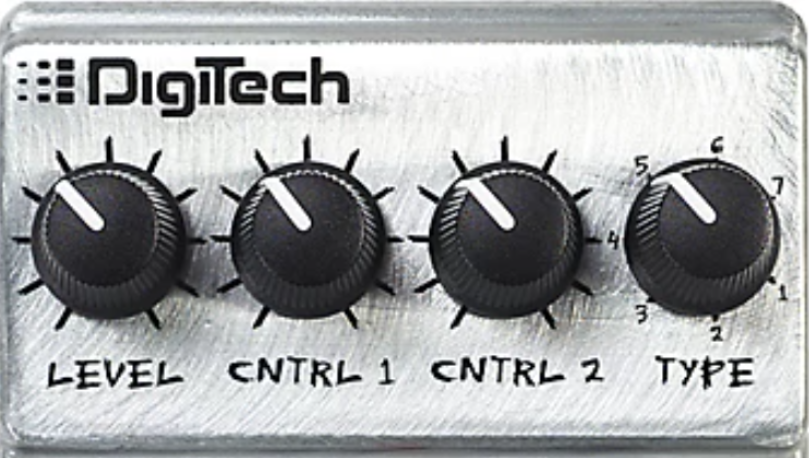

  • Controls:
    • Level: Controls the overall output volume of the pedal. Like most DigiTech pedals from this era, it can provide enough output to match your bypassed signal or push the front end of an amplifier a little harder if desired. Since each effect mode has a different perceived volume level, many players find themselves making small adjustments here as they move between the seven different Weapon sounds.

    • Cntrl 1: This is where things start to get interesting. Cntrl 1 does not perform a single fixed function. Instead, its job changes depending on which Type is selected. In the distortion-based modes it may adjust gain or effect intensity. In modulation and filter-based modes it can control things like phase depth, wah sensitivity, pitch-shift amount, or the simulated characteristics of specialty effects. Think of it as the primary editing control for whatever sound you've selected.

    • Cntrl 2: Like Cntrl 1, this knob is context-sensitive and changes function with each Type setting. Depending on the mode, it may adjust EQ characteristics, ramp speed, effect sweep, reverb amount, pitch intervals, or other secondary parameters. The combination of Cntrl 1 and Cntrl 2 is what allows The Weapon to pack several completely different effects into a single pedal without covering the enclosure in additional knobs.

    • How Cntrl 1 and Cntrl 2 work together: One thing that catches many first-time users off guard is that these two knobs behave almost like the edit controls on a small multi-effects processor. Each Type essentially becomes its own effect with its own set of adjustable parameters. As a result, the same knob positions can produce wildly different results when switching from a distortion mode to the sitar simulator, dynamic wah, pitch shifter, or phaser-based effects. Spending a little time experimenting with these controls is where the real personality of The Weapon begins to emerge.


    • Type: Selects one of seven Dan Donegan signature sounds. Each position loads a completely different effect or effect combination inspired by tones used throughout Disturbed's recordings and live performances.

      • Type 1 - "Stupify": A high-gain distortion modeled after Dan Donegan's aggressive rhythm tone from Disturbed's breakthrough hit "Stupify." Thick, saturated, and tight, this is the pedal's primary modern metal rhythm setting.

      • Type 2 - "Mistress": A medium-gain distortion based on the tone heard in "Mistress." This setting backs off some of the saturation and compression of Type 1, creating a more open distortion that responds well to picking dynamics and lower-gain riffing.

      • Type 3 - "Voices": A unique phaser-to-distortion ramp effect inspired by the song "Voices." Pressing and holding the footswitch activates a gradual transition from phasing into full distortion, creating dramatic buildups and transitions that are difficult to reproduce with conventional pedals.

      • Type 4 - "Bound": A dynamic auto-wah combined with distortion. The effect reacts to your picking attack, producing vocal-like filter sweeps while maintaining a heavy distorted tone underneath. Great for rhythmic riffs and expressive lead passages.

      • Type 5 - "Rise": A pitch-shifting distortion effect inspired by sounds used in "Rise." This mode combines heavy distortion with DigiTech's digital pitch processing to create thick, harmonically enhanced tones that stand out in a mix.

      • Type 6 - "Intoxication": A sitar simulator modeled after the unusual guitar textures heard in "Intoxication." It adds synthetic string buzz characteristics along with adjustable ambience to create surprisingly convincing sitar-like sounds without requiring any special instrument.

      • Type 7 - "Metal Master": A full-on high-gain metal distortion derived from DigiTech's Metal Master circuitry. This mode delivers the most aggressive gain structure in the pedal, with massive saturation, tight low end, and enough output to satisfy even the most gain-hungry metal players.

      Press the Play Button below to hear the original DigiTech The Weapon Sound Demos


      To help push sales, Dan Donegan later recorded a new demo featuring all 7 effects on The Weapon
      (Big file, may take a moment to load)


    • Pricing Breakdown:

      • List price: $209.00 (2004 release) Package came with The Weapon pedal, DigiTech pedal bag, DigiTech power supply, and Dan Donegan guitar pick, all in a cool looking branded box.

        • DigiTech originally set the Manufacturer's Suggested Retail Price across their "Artist Series" modeling pedals (such as The Weapon, Scott Ian's Black-13, and Eric Clapton's Crossroads) right at the $209.95 mark. This is the price that was printed on original DigiTech catalog marketing sheets and magazine advertisements.

      • Actual Street Price: $149.00

        • During its active production run between 2004 and 2007, major online retailers and storefronts (such as Music 123, Guitar Center, and Sam Ash) did not sell it at full MSRP. The regular, non-discounted "street price" out of the box was $149.00.

      • End-of-Run Blowout Price: $99.00

        • When DigiTech phased out the Artist Series line a few years later, retailers significantly marked down remaining factory stock to clear inventory. This is why archival forum posts and legacy user reviews from that era frequently mention grabbing the pedal brand new on closeout for exactly $99.00.


    • Technical info:

      • Power: 9V alkaline battery or DigiTech PS200R power supply. Battery life was listed at approximately 4 hours with continuous use, so this is one of those pedals where the power supply is really the smarter move.

      • Specifications:

        • Effect Type: Digital multi-effects pedal featuring distortion, modulation, filtering, pitch shifting, and specialty effect algorithms.

        • Signature Artist: Dan Donegan of Disturbed.

        • Sound Library: Seven dedicated artist-inspired effect modes including Stupify, Mistress, Voices, Bound, Rise, Intoxication, and Metal Master.

        • Input: Standard 1/4-inch mono guitar input.

        • Outputs: Separate Out 1 Amp output and Out 2 Mixer output with speaker-compensated direct connection capability.

        • Input Impedance: 1 MOhm.

        • Output Impedance: 100 Ohms.

        • Construction: Heavy-duty Artist-Series metal chassis designed for stage and touring use.

        • Dimensions: Approximately 4.9" (L) x 3.1" (W) x 2.1" (H).

        • Weight: Approximately 1.38 lbs.

        • Direct Recording Capability: Yes. The Mixer output allows direct connection to recording equipment, mixers, and PA systems.

        • Technology: Digital signal processing designed to reproduce multiple Dan Donegan signature sounds within a single pedal platform.


      • Component Variations: No confirmed component-side production variations have been verified yet. The most obvious collector differences appear to be condition, box, paperwork, included Artist-Series gig bag, power supply, and Dan Donegan guitar pick.

      • Notable IC Chip: Not really. Unlike some vintage analog pedals that are prized for specific op-amps or bucket brigade chips, The Weapon gets its sound from DigiTech's digital signal processing platform and custom Dan Donegan effect algorithms. The DSP architecture is more important than any individual chip inside the pedal.

      • Component-side circuitboard image: (Need to crack mine open and take a pic)

    • Heritage: The Weapon sits right in the middle of DigiTech's Artist-Series experiment, where the company worked with well-known players to create song-specific pedals instead of ordinary one-effect stompboxes. DigiTech Artist-Series Pedal Index Divider icon DigiTech X-Series Pedal Index


    • How players actually use it:

      • Disturbed-style rhythm work: The first two types are the obvious starting point. Type 1 gives you the heavier "Stupify" rhythm sound, while Type 2 backs things down for the medium distortion flavor tied to "Mistress."

      • Song-specific effects: This pedal makes the most sense when you treat it like a set of Dan Donegan snapshots. The "Voices," "Bound," "Rise," "Intoxication," "Stupify," and "Mistress" references are not random labels. They tell you what the pedal was trying to recreate.

      • Live shortcuts: The whole idea was to make complicated studio sounds easier to trigger live. That is especially true for the phaser-to-distortion ramp and the sitar setting. Those are not sounds most players would build from scratch with one regular stompbox.

      • Direct recording experiments: The Out 2 Mixer jack gives you a speaker-simulated direct option. It is not going to feel exactly like a cranked amp in the room, but for scratch tracks, direct recording, or late-night experimenting, it is part of the charm.

      • Oddball texture hunting: Even if you are not chasing Disturbed tones, the sitar simulator, pitch shifting, auto-wah behavior, and ramp effect make this pedal a fun little weird box. Sometimes the strange settings are the ones that keep a pedal interesting years later.


    • Suggested starting settings:

      • Heavy rhythm: Type 1, Level set to match bypass volume, Cntrl 1 around noon, and Cntrl 2 around noon. That is the simple starting point before adjusting the EQ feel to match your amp.

      • Medium distortion: Type 2, Level matched to your clean signal, Cntrl 1 around noon, and Cntrl 2 around noon. This is the better place to start if Type 1 feels too aggressive for the part.

      • Phaser ramp trick: Type 3, Cntrl 1 for phase amount, and Cntrl 2 for ramp time. Pressing and holding the pedal brings in the distortion ramp, which is the whole magic trick of this setting.

      • Dynamic wah: Type 4, Cntrl 1 for sensitivity and Cntrl 2 for sweep speed. Start both at noon, then adjust sensitivity around your picking attack.

      • Sitar texture: Type 6, Cntrl 1 for fret buzz character and Cntrl 2 for reverb level. This is one of those settings where going too far can get silly fast, but silly can be fun.


    • Collector notes:

      • The Weapon was sold as a Dan Donegan Artist-Series package, and the original bundle included the pedal, Artist-Series gig bag, PS200R power supply, Dan Donegan guitar pick, and owner's manual.

      • Complete examples are more interesting than loose pedals. The bag, manual, power supply, and pick are the kinds of little extras that usually disappear over time.

      • The finish and graphics are a big part of the appeal. This is not a quiet-looking pedal. It was designed to look like a signature piece from the 2000s metal era.

      • The pedal has a heavy, rugged DigiTech chassis, but used examples should still be checked for jack wear, battery compartment condition, missing release pins, and noisy controls.

      • This is one of those pedals that can be polarizing. Some players love the song-specific concept. Others want a more traditional distortion box. That divide is exactly what makes it collectible and fun to talk about.


    • Known quirks and tips:

      • The Cntrl 1 and Cntrl 2 knobs do different things depending on the selected Type, so you cannot judge the pedal by one setting. You have to treat each Type almost like its own little pedal.

      • Battery operation is possible, but with the listed short battery life, this pedal really wants the correct power supply.

      • The Out 1 Amp and Out 2 Mixer outputs are meant for different jobs. Use Out 1 into a guitar amp. Use Out 2 when going direct to a mixer or recorder.

      • Type 3 is more interactive than people expect. The press-and-hold ramp behavior is part of the effect, not just an on/off trick.

      • If the pedal sounds too processed through one amp, try a cleaner amp setting first. The Weapon already brings a lot of character to the party, and stacking too much amp gain on top can turn everything into a blender.


      Hear the DigiTech XASDD The Weapon in action:


      External Links:


      Home Divider icon America's Pedal Divider icon FX-Series Divider icon X-Series Divider icon D-Series Divider icon Artist Series Divider icon Performer Series Divider icon Hardwire Series Divider icon Specialty Pedals Divider icon New Releases Divider icon Field Guide Divider icon Serial Number info Divider icon FX literature Divider icon What's New? Divider icon FX Tech info Divider icon Links Divider icon Disclaimer/Legal/Contact Us