DigiTech Brian May Red Special
Home > DigiTech Artist Series Pedal Index > DigiTech Brian May Red Special

"This piece of gear is, in my opinion, a work of genius! I claim no credit! An amazing DigiTech team led by legend Eddie Kramer have created a device capable of making anybody sound like me! (If you should want to, that is!) Through an incredible new modeling technique, this pedal captures 14 of the most memorable tones I've achieved for Queen over the years...Plug in and turn it up - and ROCK! Cheers!" —Brian May

Making it's debut on July 14, 2006 at the Summer NAMM show in Austin, Texas, the DigiTech Brian May Red Special was far more than just another signature pedal. DigiTech set out to capture an entire guitar rig, a recording approach, and decades of Queen history in a single floor unit.
The Red Special was also the last of the five Artist Series pedals to be released and, as of this writing, the most expensive of the bunch on the used market. This was not just a normal multi-effects pedal with a famous name stamped on it. DigiTech built this thing around Brian May's actual Queen tones, working with Brian and Eddie Kramer to capture sounds connected to specific songs, studio moments, live rigs, and some of the most recognizable guitar parts in rock history.
What makes this pedal so interesting is that it is trying to do a whole chain, not just one effect. You are dealing with Red Special guitar modeling, treble booster behavior, Vox AC30 style response, Deacy amp textures, tape flanging, phaser, delay, harmony, chorus, cabinet modeling, and direct-output flexibility all stuffed into one big red treadle box. Is it the same as standing in front of Brian's real rig with his guitar in your hands? Of course not. But for a DigiTech Artist Series pedal, this one has a ton of personality, and it is a very cool snapshot of what DigiTech was willing to attempt in the mid-2000s.
Now, let's get into it =)
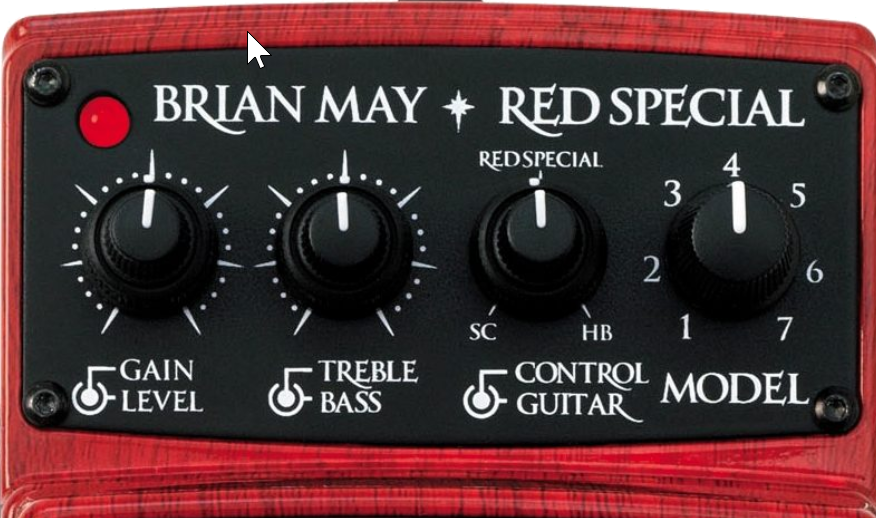
Controls:
- Gain/Level: This is where the fun starts. Depending on which model you've selected, the Gain control can take you from a fairly clean Brian May-style edge-of-breakup sound all the way into the singing sustain that made so many Queen solos instantly recognizable. The Level control simply lets you balance everything out with the rest of your rig. One thing I've noticed is that this pedal generally sounds best when you give it a little room to breathe instead of immediately cranking everything to the stops.
- Treble/Bass: If there's one thing people associate with Brian May's tone, it's that unmistakable top-end chime. The Treble/Bass control lets you dial that in for your particular guitar and amplifier. Some rigs will need a little extra sparkle while others may need the edge taken off. Don't be afraid to experiment here. Small adjustments can make a surprisingly big difference.
- Control/Guitar: This is one of those controls that makes a lot more sense once you spend some time with the pedal. Different models use it differently, but its main job is helping the pedal react properly with different guitars and pickups. Brian's homemade Red Special doesn't behave exactly like a Strat, Les Paul, Telecaster, or anything else most of us have hanging on the wall. This control helps bridge that gap.

- Model Selector: This is really the whole reason the pedal exists. Instead of giving you a single Brian May sound, DigiTech tried to capture several different chapters of his career and put them under one footswitch. Some focus on specific songs, some focus on specific rigs, and some recreate sounds that are nearly impossible to get without a pile of vintage gear.
- Bohemian Rhapsody: Probably the setting most people head for first. This is all about those rich, layered lead sounds and harmonized guitar parts that helped turn an already ambitious song into one of the most recognizable recordings ever made.
- Tie Your Mother Down: If you want Brian with a little more attitude, this is where you'll probably spend some time. It's punchy, aggressive, and feels more like standing in front of a loud amp than sitting in a recording studio stacking guitar tracks.
- We Will Rock You: Big, bold, and built for lead work. This setting has that soaring quality that made Brian's solos stand out in arenas packed with people singing at the top of their lungs.
- Brighton Rock Solo Live: This one is worth the price of admission all by itself. The famous delay-based guitar orchestration from Brian's live performances is here, and it's every bit as entertaining to play as you'd expect. You can lose a lot of time having fun with this setting.
- Keep Yourself Alive: This takes you back to the early days before Queen became one of the biggest bands on the planet. The sound feels a little rawer, a little more direct, and gives you a glimpse into where it all started.
- Deacy / A Winter's Tale: One of the most fascinating settings on the pedal. Brian's little Deacy amplifier produced sounds that often didn't even seem like guitar. The textures here can be surprisingly orchestral and are unlike anything most guitar players normally use.
- Brian May Solo: If the other settings are snapshots of specific moments, this one feels like a collection of Brian's greatest hits rolled into a single lead sound. Rich sustain, vocal-like phrasing, and plenty of harmonic character.
- Expression Pedal with Toe and Heel Switching: This isn't just a volume pedal bolted onto the side. Depending on the model, it can change effect levels, switch between different sounds, control delays, or completely transform how the preset behaves. A lot of players overlook it at first, but the expression pedal is a huge part of what makes the Red Special feel alive under your feet.

Pricing breakdown:
- Retail Price: $299.99 (July 2006)
- Street Price: $199.99 (2006 - 2007)
- Closeout Price: $179.99 (2008 - 2009)
- Today 6-10-26 $289 (pedal only) all the way up to $525 or more for the complete set in great condition (America) and can go for $900 or more from China. Special note: The Red Special box originally came with a Sixpence coin (see below) as a nod to Brian's preference for using one as a guitar pick. Finding a Red Special with this original Sixpence can command crazy money!

Technical info:
- Power: Uses the included DigiTech PS0913B 9V AC power supply. No battery operation.
- Specifications: Under the hood, the Red Special is much more than a typical stompbox. DigiTech packed seven Brian May-inspired sound collections into a single floor unit along with amp modeling, cabinet simulation, delay effects, modulation, harmony processing, EQ shaping, and expression pedal control. Separate amplifier and mixer outputs make it equally comfortable feeding a traditional guitar amp, a recording interface, or a live PA system. The pedal measures approximately 10.14" x 3.84" x 2.47" and weighs about 3.38 lbs.
- Component Variations: Unlike many vintage DOD and DigiTech pedals where collectors spend years chasing different circuit revisions, there is nothing to chase here.
- Notable IC Chip: Nope. At least not in the way vintage pedal collectors usually think about it. Nobody is buying a Brian May Red Special because it contains some legendary op amp or hard-to-find transistor. The real magic lives in the modeling software and the work DigiTech did with Brian May and Eddie Kramer to capture those famous Queen tones. In this case, the sound is the story, not a particular chip hiding on the circuit board.
- Component-side circuitboard image: (On my to do list)
Heritage: The Weapon  Black-13 Crossroads Jimi Hendrix Experience.

How players actually use it:
- Queen tone hunting: This is the obvious one. Players grab this pedal because they want Bohemian Rhapsody, Brighton Rock, We Will Rock You, Tie Your Mother Down, or Deacy-style layered guitar sounds without building a laboratory in the corner of the room.
- Direct recording: Out 2 is voiced for mixer or recording use, and that is one of the most useful parts of the pedal. You can plug it straight into a recording setup and get a finished-ish Brian May flavored sound without miking an amp.
- Into a clean amp: A clean or lightly broken-up amp is usually the friendliest place to start. If the amp is already too gainy or too dark, the pedal can get congested fast.
- As a Brian-flavored preamp: Some players use it less like a stompbox and more like a front-end tone machine. Pick a model, set the guitar type correctly, dial the EQ, and let it be the whole sound.
- For studio texture: The Deacy and harmony sounds can be fun even when you are not trying to play Queen note-for-note. They have that odd, layered, slightly magical thing that can make a track feel bigger than it should.

Suggested starting settings:
- Basic Queen lead sound: Start with the Bohemian Rhapsody model, Gain around noon, Level to match bypass volume, Treble around 1 o'clock, Bass around 11 o'clock, and Guitar set for your pickup type.
- Big live-style delay sound: Try the Brighton Rock Solo Live model, use the toe mode first, bring the delay amount up with the expression pedal, and keep your picking clean. This setting will tell on you in a hurry.
- Deacy-style layered parts: Use the Deacy / A Winter's Tale model, back the Gain down a bit, keep the Bass controlled, and let the midrange do the heavy lifting.
- Rock rhythm: Tie Your Mother Down is a great starting point when you want something more direct and less studio-special-effect. It feels more like a proper rock amp sound than some of the more theatrical models.
- Using a Les Paul or humbuckers: Set the Guitar control toward HB first. Do not assume more treble automatically fixes everything. Sometimes backing off the gain and letting the model breathe is the trick.

Collector notes:
- Complete examples are the ones to watch. The original package included the pedal, Red Special Artist Series gig bag, sixpence plectrum, PS0913B power supply, manual, warranty card, and brochure.
- The sixpence pick is easy to lose, so do not be surprised when used examples are missing it. That little piece matters more to collectors than casual buyers usually realize.
- The correct power supply matters. This is a 9V AC DigiTech supply pedal, not a standard 9V DC stompbox situation.
- These have become more desirable over time because Queen fans, Brian May fans, and DigiTech Artist Series collectors are all chasing the same box.
- Condition around the treadle, graphics, jacks, and power supply area tells you a lot about how hard the pedal was used.
- Do not overlook the bag and paperwork. With Artist Series pedals, the extras help tell the story.

Known quirks and tips:
|
