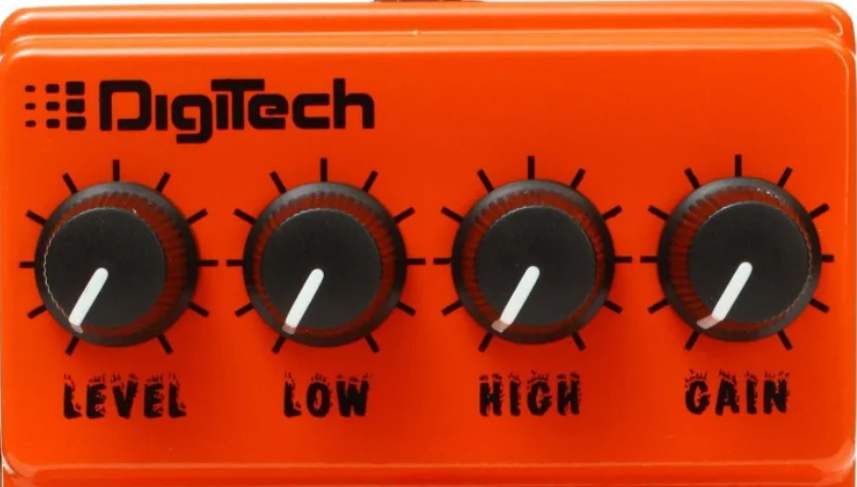
The DigiTech DHH Hot Head Distortion is one of those orange boxes that makes a lot more sense once you actually plug into it and start twisting knobs. On the surface, it looks like a straight-ahead distortion pedal from the affordable DigiTech D-Series lineup, and honestly, that is exactly what it is. But the Hot Head has a little more range than some players expect. It is not locked into one single flavor of distortion. It can do a rough classic rock grind, a tighter hard rock rhythm sound, and enough gain to get into heavier territory without completely turning into a swarm of angry bees.
What makes the Hot Head especially useful is the separate Low and High EQ controls. A lot of distortion pedals in this price range give you one tone knob and wish you luck. The Hot Head gives you more room to shape the bottom end and top end independently, which makes a big difference when you are trying to match the pedal to different guitars, amps, speakers, and rooms. It is a practical pedal, a loud pedal, and a much more flexible little monster than some folks give it credit for.
Now for the nitty-gritty =)
Controls:
Level: Controls the overall output volume of the pedal. Think of this as the final volume control after all of the distortion and EQ shaping has taken place. Unity gain is typically somewhere around the middle of the knob's travel, but there is plenty of additional output available if you need to push the front end of an amp a little harder. The Hot Head has enough volume on tap to function as both a distortion pedal and a lead boost when desired.
Low: Adjusts the amount of bass frequencies entering the final output signal. This control is one of the reasons the Hot Head is more versatile than many distortion pedals from its era. Turning it clockwise adds body, punch, and low-end thump, making single notes sound larger and power chords feel heavier. Turning it counterclockwise tightens the sound and removes excess boominess, which can be especially useful when playing through darker amplifiers or using higher gain settings.
High: Controls the amount of treble and upper-frequency presence in the distorted signal. This knob has a significant effect on the personality of the pedal. Lower settings produce a warmer, smoother distortion that works well for classic rock and thicker rhythm tones. Higher settings increase bite, attack, and clarity, helping notes cut through a band mix. Players should experiment carefully, as small adjustments can dramatically change the pedal's overall character.
Gain: Controls the amount of distortion generated by the circuit. At lower settings the Hot Head produces a gritty, slightly overdriven sound that can work surprisingly well for bluesy rock and vintage-inspired tones. As the control is increased, the pedal moves into classic hard rock territory before eventually delivering thick, saturated distortion capable of handling modern rock and heavier styles. Unlike some pedals that seem to have only two useful gain settings, the Hot Head offers a wide range of usable sounds throughout most of the control's sweep.
List price: $59.95 (street price $39 - $49)
Technical info:
Power: Standard 9 volt DC pedal power or 9 volt battery operation. Use a standard center-negative supply unless further documentation proves otherwise.
Specifications: Fully analog distortion pedal featuring independent Low and High EQ controls, a wide gain range, high output capability, standard 9-volt operation, and rugged metal construction. Designed as a flexible all-purpose distortion capable of covering everything from light crunch and classic rock drive to thick, saturated high-gain tones.
Component Variations: No major production variations are currently known. Additional research is ongoing.
Notable IC chip: Nope. The circuit is an analog, op-amp-based distortion that used standard, widely available operational amplifiers (typically generic dual op-amps like the TL072 or 4558) and hard-clipping diodes to achieve its sound. As always, I'm on the look for more data and will continue the research.
Heritage: The Hot Head belongs to the same practical, affordable DigiTech D-Series family that gave players pedals like the Bad MonkeyScreamin' BluesDeath MetalGrunge. The Hot Head was the more general-purpose distortion of the bunch. It was not as wild as the Grunge, not as extreme as the Death Metal, and not as overdrive-focused as the Bad Monkey. It sat right in the useful middle, which is exactly why it deserves its own place in the story.
How players actually use it:
Classic rock crunch: Back the Gain down and keep the EQ controls close to noon. The Hot Head can get a nice gritty rhythm sound that works well for older rock, garage rock, and simple plug-in-and-play riffs.
Hard rock rhythm: Push the Gain up, add a little Low, and keep the High from getting too sharp. This is where the pedal starts to feel like a small amp being pushed harder than it probably should be.
Lead boost with attitude: Set the Level a little above unity and use the EQ to cut through. It is not a polite solo boost. It has some teeth, which can be exactly what you want when the guitar needs to step forward.
Bedroom amp rescue duty: A lot of small practice amps sound thin and flat by themselves. The Hot Head can add body, sustain, and some much-needed excitement without requiring a giant amp stack in the living room.
Alternative to one-knob distortion pedals: The Low and High controls let you dial around problems instead of just accepting whatever the pedal gives you. That is a big part of the Hot Head's charm.
Press the Play Button below to hear the original DigiTech DHH Hot Head Distortion Sound Demo (2009)
Now that you've heard the demo, try these settings:
Basic rock rhythm: Level at noon, Low at noon, High around 11 o'clock, Gain around 1 o'clock. This is a good starting point for crunchy rhythm playing without letting the pedal get too fizzy.
Thicker hard rock sound: Level at noon, Low around 2 o'clock, High around noon, Gain around 2 o'clock. This gives the pedal more weight and sustain while still keeping some control over the top end.
Sharper lead tone: Level slightly above noon, Low around 11 o'clock, High around 1 o'clock, Gain around 2 o'clock. This setting helps the guitar pop out more without completely disappearing into the mix.
Lower gain surprise: Level at noon or slightly higher, Low at noon, High around noon, Gain around 9 or 10 o'clock. The Hot Head is not just a max-gain box. There are some useful lower gain sounds hiding in there.
Heavy but controlled: Level at noon, Low around 1 o'clock, High around 10 or 11 o'clock, Gain around 3 o'clock. This keeps the top end from getting too raspy while still giving you plenty of distortion.
Collector notes:
The bright orange enclosure makes the Hot Head easy to spot, and that is always a plus when you are digging through pedal bins, pawn shop cases, or old gig bags.
The D-Series pedals were affordable working-player pedals, so expect many used examples to show real wear. That is not always a bad thing. It usually means somebody actually used the thing.
Original boxes, paperwork, and clean battery compartments always matter to collectors. These pedals were not always treated like collectibles when they were new.
The Hot Head tends to be overshadowed by the Bad Monkey, Grunge, and Death Metal, but that makes it more interesting to me. Sometimes the less-hyped pedals are the ones that surprise you later.
If you collect the D-Series, the Hot Head is one of the essential orange pieces in the lineup. It helps tell the full story of how DigiTech was covering overdrive, distortion, grunge, and metal in a very player-friendly way.
Known quirks and tips:
The High control can make the pedal bright in a hurry, especially through a clean solid-state amp or a bright speaker. Do not be afraid to back it down.
The Low control is useful, but too much low end can make high-gain settings feel loose. Start around noon and adjust from there.
The Gain control has a pretty wide sweep. The fun is not always at full blast. Some of the best sounds may be hiding between 10 o'clock and 2 o'clock.
Like a lot of affordable distortion pedals, the Hot Head reacts differently depending on the amp. Through a warm tube amp it can feel bigger and smoother. Through a tiny practice amp it may need more careful EQ.
If the pedal sounds harsh, do not blame it too quickly. Roll back the High, trim the guitar's tone knob a hair, and make sure the amp is not already set painfully bright.
Hear the The DigiTech DHH Hot Head Distortion in action: