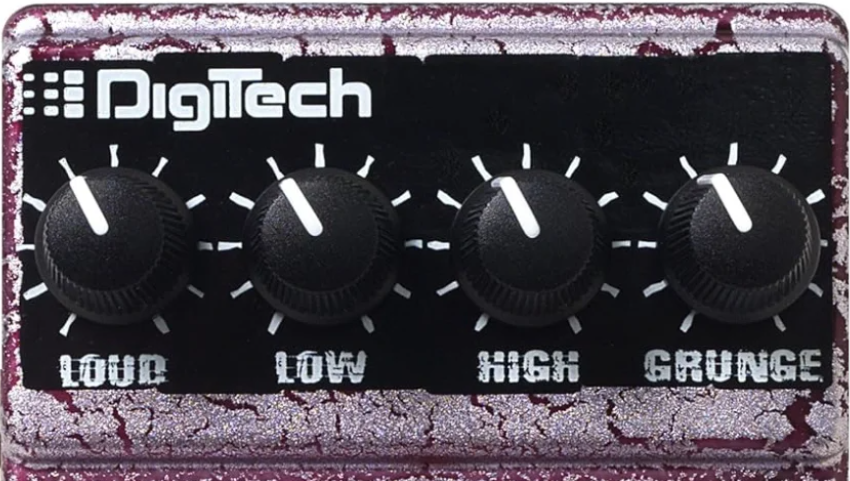
The DigiTech DGR Grunge is one of those pedals that instantly takes you back to the loud, reckless spirit of the 1990s. Whether you loved it or hated it, there was never much middle ground. This little purple box became famous for delivering a massive wall of distortion that was raw, aggressive, and completely unapologetic. While many distortion pedals were trying to sound smooth and refined, the Grunge seemed determined to kick the front door off the hinges.
Part of the original DigiTech D-Series lineup, the Grunge was aimed at players chasing the heavier sounds that were dominating radio stations, clubs, garages, and bedrooms at the time. It could produce everything from chunky alternative rock rhythms to chainsaw-like saturation that bordered on sonic chaos. Decades later it remains one of the most recognizable pedals DigiTech ever produced and has become something of a cult favorite among players who appreciate its unique personality.
Let me close out this introduction by saying if you've ever spent time with a DOD FX69 Grunge, you'll notice some familiar territory here. The DigiTech DGR Grunge wasn't an exact copy, but it definitely felt like a solid spiritual successor. Both pedals were built around the idea that subtlety is overrated, delivering massive gain, powerful EQ controls, and enough attitude to make a Marshall stack nervous LOL! The FX69 opened the door. The DGR kicked it down.
Now let's get into it =)
Controls:
Loud: Controls the overall output level of the pedal. Despite the simple name, there is plenty of volume available here. The DGR can easily push the front end of an amplifier harder than your clean signal, allowing it to function as both a distortion pedal and a surprisingly effective boost. Most players find unity gain around the middle of the control's range, depending on how much Grunge is dialed in.
Low: An active bass EQ control that has a dramatic effect on the overall character of the pedal. Turn it down and the Grunge becomes tighter, more focused, and less overwhelming. Turn it up and the pedal develops the thick, chest-thumping low end that became one of its trademarks. Unlike many distortion pedals of the era that offered limited EQ options, the Grunge gives players enough bass control to move from sharp garage rock tones to huge wall-of-sound distortion.
High: Active treble EQ control. This knob determines how much bite, edge, and top-end aggression is present in the signal. Lower settings smooth out the harshness and tame some of the pedal's naturally abrasive personality. Higher settings add attack, pick definition, and enough cutting power to slice through even dense band mixes. Combined with the Low control, it gives the player far more tonal flexibility than many people realize.
Grunge: The gain control and the heart of the entire pedal. This adjusts the amount of distortion, saturation, sustain, and overall nastiness. Lower settings produce chunky overdrive and alternative rock crunch, while higher settings unleash the chainsaw-like wall of distortion that made the pedal famous. The interesting thing about the Grunge control is that many players discover their favorite sounds somewhere between noon and three o'clock rather than fully maxed out. There is so much gain available that even moderate settings can deliver serious saturation.
List price: $59.95 USD (street price $39 to $49)
Technical info:
Power: 9V battery or standard 9V DC adapter
Specifications: Analog distortion effect utilizing a high-gain clipping circuit paired with an active two-band EQ section. Control set consists of Loud (output level), Low (active bass EQ), High (active treble EQ), and Grunge (gain/distortion). Designed to deliver massive amounts of saturation while allowing extensive tone shaping through its powerful EQ controls. Features mono input and output, electronic switching, operation from a 9-volt battery or external power supply, and DigiTech's durable D-Series steel chassis. Known for producing one of the most aggressive and instantly recognizable distortion voices in the DigiTech catalog, with enough gain available to cover everything from heavy alternative rock to near-fuzz levels of saturation.
Component Variations: The Grunge was produced for many years, and along the way DigiTech made the kinds of manufacturing changes you'd expect from a pedal with a long production run. Different circuit board revisions, component substitutions, and layout changes have all been observed by collectors. The good news is that DigiTech appears to have worked hard to maintain the pedal's trademark sound regardless of what was happening on the circuit board. I've seen players spend hours debating whether an early Grunge sounds better than a later one, but in practical use the differences tend to be subtle at best. For collectors, however, these production variations make the Grunge a surprisingly interesting pedal to study, especially when comparing examples from different years and manufacturing periods.
Notable IC chip: I almost left this section out because the Grunge has never been one of those pedals where people obsess over a particular chip. Nobody buys one of these animals looking for specific guts, they buy it because they want to plug in and rip someone's face off. While DigiTech made various production changes over the years, the Grunge always kept its signature sound. DigiTech bottled up a huge, angry, rip-your-face-off, chainsaw distortion and stuffed it into a little purple stompbox that guitar players still talk about today.
90s Alternative Rock: This is probably the sound most people associate with the pedal. Big, aggressive rhythm tones with plenty of attitude and enough saturation to make power chords sound enormous.
Garage Rock: The Grunge excels when players want something rough around the edges. It can sound dirty, unruly, and wonderfully imperfect in a way that polished modern pedals often cannot.
Stoner and Doom Experiments: Crank the Low and Grunge controls and things can get huge in a hurry. Some players have discovered surprisingly effective doom and sludge tones hiding inside this little purple box.
Recording Texture Layers: Even players who do not use it as their primary distortion often keep one around for layering tracks because nothing else quite sounds like a Grunge pedal when it is pushed hard.
Press the Play Button below to hear the original DigiTech BGR Grunge Sound Demo (2009)
Now that you've heard the demo, try these settings:
Classic Grunge Rhythm: Loud 12:00, Low 1:00, High 11:00, Grunge 2:00. This captures the thick, aggressive character that made the pedal famous.
Heavy Modern Crunch: Loud 12:00, Low 2:00, High 1:00, Grunge 11:00. Backing down the gain slightly often produces a bigger and more usable sound than running everything wide open.
Garage Band Mayhem: Loud to taste, Low 3:00, High 2:00, Grunge maxed. Sometimes subtlety is overrated.
Lead Tone: Loud 1:00, Low noon, High 2:00, Grunge 2:00. The extra top end helps solos cut through a mix.
Collector notes:
The Grunge is one of the most recognizable pedals DigiTech ever released. Even non-pedal collectors often know exactly what it is when they see that famous purple enclosure.
Original examples remain relatively affordable compared to many vintage effects, making them an accessible piece of 1990s pedal history.
Boxed examples with original paperwork are becoming noticeably harder to find than loose pedals.
Its reputation has gone through several cycles. Once mocked by some players, it is now increasingly appreciated for being unique rather than trying to imitate something else.
The Grunge and Death Metal pedals helped define DigiTech's image for an entire generation of guitar players.
Known quirks and tips:
The EQ section is extremely powerful. Small adjustments can make surprisingly large changes to the overall sound.
Running every control at maximum is fun for about five minutes. Most players eventually discover that backing off one or two controls produces a much more useful tone.
The pedal can generate a substantial amount of gain and noise. A noise gate may be helpful for very high-gain applications.
It responds surprisingly well to guitars with lower-output pickups, where some of its complexity becomes easier to hear.