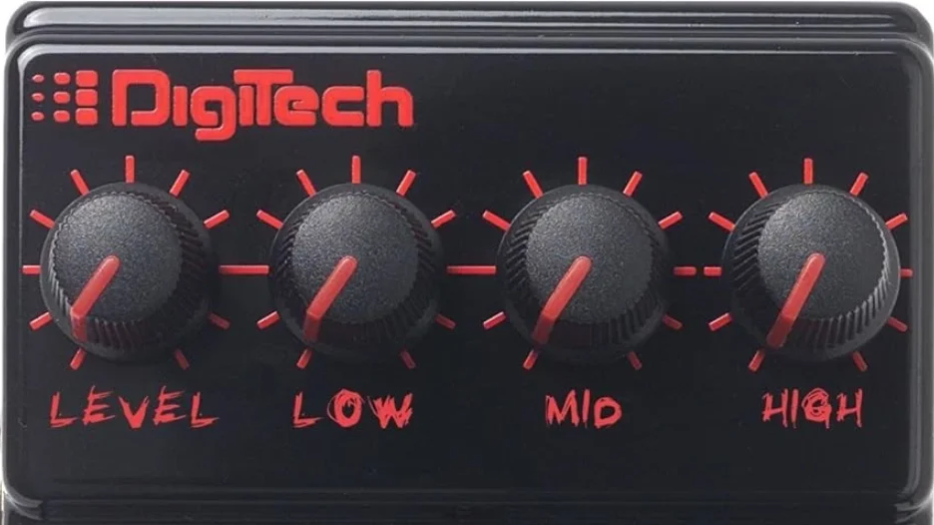
The DigiTech DDM Death Metal Distortion is not the pedal you buy when you want a polite little edge-of-breakup sound. This thing was built for one purpose: huge, saturated, aggressive distortion. DigiTech even leaned into the joke in the original manual by saying they turned the gain up to eleven and ripped the knob off. That pretty much tells you everything you need to know before you ever plug a cable into it.
What makes the Death Metal interesting is that there is no Gain control. The distortion is already wide open. Instead of letting you decide how much gain you want, it gives you Level, Low, Mid, and High controls so you can shape the damage after the fact. That makes it a very different animal from the Hot Head, Bad Monkey, or Screamin' Blues. The DDM is not trying to be versatile in the traditional sense. It is trying to be extreme, and then giving you enough EQ control to aim the blast where you want it.
The DDM also carries the spirit of the earlier DOD Death Metal idea into the DigiTech D-Series era. It has that same wild, over-the-top personality, but in the later DigiTech housing with dual outputs, including an Amp output and a Mixer output with speaker cabinet emulation. That little detail matters because it shows DigiTech was not just selling a loud black box. They were also thinking about direct recording, practice setups, and players who wanted to run the pedal into something other than a regular guitar amp.
I mentioned in the introduction of the Grunge pedal that you bought that pedal because you wanted to rip someone's face off. That was true, however, if you wanted to totally decimate someone (or a crowd) you plugged into the Death Metal and released some real carnage!
Now lets dive in =)
Controls:
Level: Controls the overall output volume of the pedal. Since the distortion itself is permanently cranked, this knob is your main way of matching the DDM to the amp, recorder, mixer, or next pedal in line. Start lower than you think, because this pedal can hit the front end of an amp pretty hard. Once the EQ is where you want it, bring the Level up until the pedal sits where it needs to sit in the rig.
Low: Boosts or cuts the bass frequencies. This control is a big part of the Death Metal experience because the pedal can get massive in a hurry. Turn it up and the sound gets heavier, bigger, and more dangerous, especially for palm-muted riffs. Back it down and the pedal tightens up, which can help keep fast picking and low-tuned guitars from turning into mud. The trick is not always to max it. The trick is to find the point where the bottom end feels huge but still responds.
Mid: Boosts or cuts the midrange frequencies. This may be the most important control on the entire pedal. Pull the mids back and you get that scooped, angry, bedroom-metal sound a lot of players associate with the Death Metal. Push the mids up and the guitar starts to poke through better, especially in a band mix. A lot of players discover that the DDM sounds more useful when the Mid control is not buried. Scooped sounds are fun by yourself, but mids are what keep the guitar alive when drums and bass show up.
High: Boosts or cuts the treble frequencies. This is where the bite, edge, and nasty top-end attack live. Higher settings can help riffs slice through, but they can also make the pedal sound harsh through bright amps or small speakers. Lower settings warm it up and keep the fizz under better control. With this pedal, the High control is not just a tone sweetener. It is one of the main weapons for deciding whether the sound is brutal, buzzy, cutting, or completely out of control.
List price: $69.95 (street price $49.95)
Technical info:
Power: Standard 9 volt alkaline battery operation or optional DigiTech PS200R power supply. The original manual lists approximately 21mA current draw at 9VDC and approximately 18 hours of battery life with continuous use.
Specifications: Controls: Level, Low, Mid, High, and On/Off pedal. Jacks: Input, Amp Out, and Mixer Out. Input impedance: 1 MOhm. Output impedance: 100 Ohms. Dimensions: 4 15/16 inches long x 3 1/8 inches wide x 2 1/8 inches high. Weight: 1.38 lbs.
Component Variations: No verified component-side production variations are currently documented here. The larger Death Metal family does include the earlier DOD Death Metal versions before this DigiTech DDM version, but I am separating family history from confirmed DDM circuitboard variation. If I can verify different board revisions, chip changes, or documented production differences, I will update this section.
Notable IC chip: Needs further research to verify. This is an analog high-gain distortion pedal, and op-amps are absolutely ICs, but I do not want to name a specific "famous chip" without verified board evidence. The important point for now is that the DDM's reputation comes from its fixed maximum-gain design, hard-edged distortion voice, and active tone shaping, not from a widely celebrated proprietary chip like you would talk about in some digital DigiTech units.
Extreme metal rhythm: This is the obvious use, and honestly, it is where the pedal's name points you. Big palm-muted riffs, fast tremolo picking, low-tuned guitars, and aggressive rhythm parts are the home turf.
Noise rock and ugly textures: The DDM is not always about tight modern metal. It can also be great when you want something rude, nasty, and almost broken-sounding. Some pedals are too smooth for that job. This one is not.
Lead sustain for days: Because the gain is already maxed, single notes can hang on much longer than you might expect from an affordable distortion box. It is not a refined singing lead tone, but it can be a wonderfully over-the-top one.
Direct recording experiments: The Mixer output with speaker cabinet emulation gives players a way to run straight into a mixer or recorder. It is not the same as a modern impulse response setup, but for its era, that was a useful feature.
Stacking carefully: Some players put a boost, overdrive, EQ, or noise gate around it to tighten the response. You have to be careful, because the pedal is already doing a lot. But with the right setup, it can become more controlled without losing its attitude.
Press the Play Button below to hear the original DigiTech DDM Death Metal Sound Demo (2009)
Now that you've heard the demo, try these settings:
Classic Death Metal chaos: Level to taste, Low around 2 o'clock, Mid around 10 o'clock, High around 1 o'clock. This gives you the big scooped personality most people expect when they first step on one.
Tighter rhythm sound: Level at unity, Low around noon, Mid around 1 o'clock, High around noon. This keeps the bottom end from getting too loose and lets the guitar stay more present.
Huge bedroom metal sound: Level to taste, Low around 3 o'clock, Mid around 9 o'clock, High around 2 o'clock. This is not the most practical band setting, but it is fun, and fun still matters.
Lead sustain setting: Level slightly above unity, Low around 11 o'clock, Mid around 2 o'clock, High around 1 o'clock. Raising the mids helps single notes jump forward and keeps leads from disappearing.
Less fizz, more weight: Level to taste, Low around 1 o'clock, Mid around noon, High around 10 o'clock. This is a good place to start if the pedal sounds too raspy through your amp.
Collector notes:
The black enclosure with red Death Metal graphics has a personality all its own. It is one of those pedals that looks exactly like it sounds.
Because this was an affordable working-player pedal, many examples were used hard. Scratches, missing battery doors, worn rubber, and beat-up boxes are not surprising.
Original packaging, paperwork, and clean battery compartments are worth paying attention to. Players bought these to make noise, not to preserve them for museum shelves.
The DDM is important because it carries the Death Metal idea from the DOD world into the DigiTech D-Series era. That makes it more than just another high-gain distortion pedal.
It has a reputation for being outrageous, noisy, and sometimes ridiculous. To me, that is part of the charm. Not every pedal needs to behave like it was designed for a polite dinner party.
Collectors who focus only on boutique or expensive pedals may miss this one, but the Death Metal belongs in the story because so many players actually owned, used, abused, and remembered it.
Known quirks and tips:
There is no Gain knob because the gain is already fixed at full blast. That is not a defect. That is the whole personality of the pedal.
A noise gate can be very helpful, especially with high-output pickups, boosted amps, or stop-start riffing. The DDM is not shy about hiss and noise.
The Mid control matters more than many players realize. If the pedal sounds impressive alone but disappears with a band, try adding mids before blaming the pedal.
The Mixer output uses speaker cabinet emulation and is meant for direct connection to a mixer or recording device. The Amp output is the one to use for a normal guitar amplifier setup.
Do not automatically dime all three EQ knobs. That can be fun for five minutes, but the pedal usually becomes more useful when the EQ is treated like a real tone-shaping section.
If it sounds too harsh, lower the High control first. If it sounds too loose, lower the Low control. If it sounds too scooped or small in a mix, raise the Mid control. Simple, but it works.
Hear the The DigiTech DDM Death Metal Distortion in action: