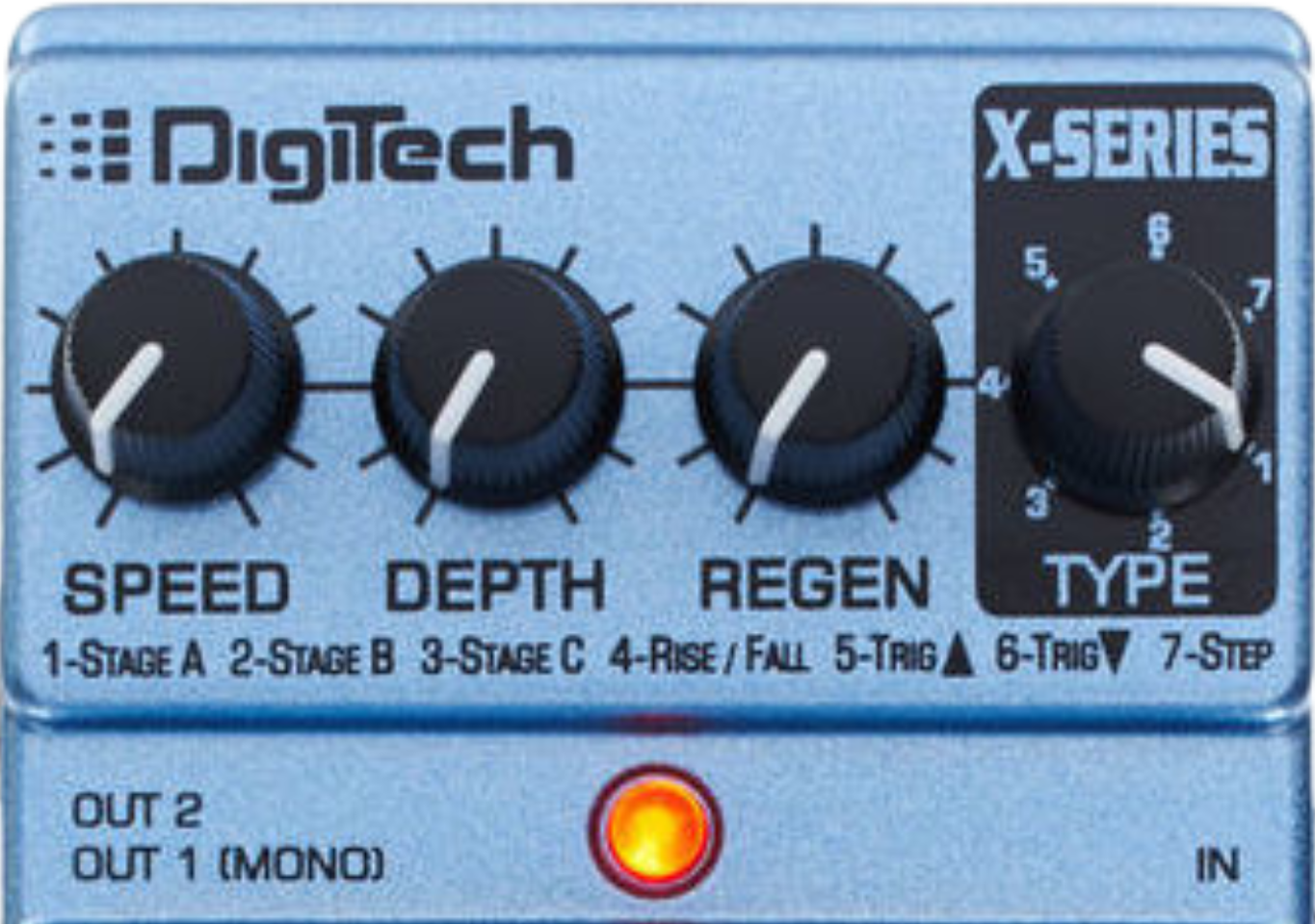
The DigiTech XHP Hyper Phase is one of those X-Series pedals that quietly does a lot more than people expect. Released during DigiTech's early 2000s push into more advanced digital stompboxes, the Hyper Phase took a category most players thought they already understood and opened it up quite a bit. Instead of giving you one familiar swirl and calling it a day, DigiTech built this thing around seven distinct phase types, stereo operation, and enough range to move from old-school wash to weird, almost synth-like movement.
That is what makes it interesting. This pedal can absolutely do the classic phaser thing, but it also reaches into territory that traditional one-voice phasers never really touched. Four-stage, eight-stage, and twelve-stage sounds are all here, along with rising and falling sweeps, triggered modes, and the random Step effect. In other words, this is not just a "phase pedal." It is DigiTech taking the idea of phasing and asking, "How far can we push this in one box?"
From the manual:"The Hyper Phase is a multi-function phaser pedal that offers seven different types of phasing effects and CIT™ cabinet modeling."
Now, let's get into it =)
Controls:
Speed: Controls the speed of the phase sweep. Turn it clockwise for faster movement and counter-clockwise for slower, more spacious sweeps.
Depth: Controls the intensity of the phase effect. Lower settings keep things subtle, while higher settings get much more dramatic.
Regen: Controls regeneration, or feedback, in most modes. In Rise/Fall mode it determines whether the sweep rises or falls, and in Trigger Up/Down it adjusts trigger sensitivity.
Type: Selects one of the seven phaser voices.
1 - Stage A: 4-stage phaser
2 - Stage B: 8-stage phaser
3 - Stage C: 12-stage phaser
4 - Rise / Fall: Constant rising or falling phase sweep depending on the Regen setting
5 - Trig Up: Sweep starts from the bottom when the trigger threshold is reached
6 - Trig Down: Sweep starts from the top when the trigger threshold is reached
7 - Step: Random square-wave style phasing similar to a sample-and-hold synth effect
Note: Trigger Up and Trigger Down use the Regen knob as threshold sensitivity, and regeneration is fixed in those modes.
List price: $69.95 (May 2006)
Technical info:
Circuitry: Digital stereo phaser
Dual output: Out 1 (Mono) and Out 2 for stereo operation
Construction: Heavy-duty metal housing
Dimensions:
Length: 4 15/16 inches (approx. 125 mm)
Width: 3 1/8 inches (approx. 79 mm)
Height: 2 1/8 inches (approx. 54 mm)
Weight: 1.38 lbs (approx. 0.63 kg)
Input Impedance: 1 MOhms
Output Impedance: 100 Ohms
Power Supply: 9V battery or DigiTech PS200R 9V DC adapter
Battery Life: Approximately 4 hours continuous use
Special feature: Built-in CIT™ cabinet modeling for direct use into a mixer or recorder
Component-side circuitboard image: (On the to-do list)
Now, here is where this one gets really interesting...
The Hyper Phase is not just another phaser in the lineup. It sits right in the middle of a major transition point for DigiTech.
This pedal comes out of that early 2000s X-Series push where DigiTech was basically saying, "We're not going to be limited by what analog pedals used to do." That is where the whole multi-mode idea really took hold. Seven different phase types in one box, including Step and Trigger modes...that was not normal for a stompbox at the time. That kind of thing lived in rack gear or those earlier experimental units.
A big part of that was the AudioDNA chip. That is what made things like Rise, Fall, and Step possible without the pedal falling apart. You start to see DigiTech thinking less like a pedal company and more like a DSP company that happens to make pedals.
And if you follow that line forward, you can see exactly where it goes. The HardWire SP-7 Stereo Phaser is basically the next step in the evolution. Same idea, same multi-mode layout, just cleaner, higher headroom, and dressed up for the "boutique" crowd that came along later.
At the same time, some of the stranger stuff in the Hyper Phase did not disappear. It just moved sideways. The Step and rhythmic-style modulation ideas show up again in things like the HardWire TR-7, where DigiTech leaned even harder into that pattern-based movement.
This pedal also landed right in that early 2000s window where heavier music was getting more experimental. You start hearing this kind of modulation show up in places you would not expect, and players were using it more as a texture tool than just a background swirl.
What is funny is that for a long time, pedals like this got overlooked because they were "too digital." Now it has kind of come full circle. The Hyper Phase has become one of those sleeper pedals people grab specifically because it does things a lot of modern analog phasers still cannot really touch, especially once you get into Step and Trigger territory.
It is one of those pieces that makes a lot more sense when you zoom out and look at the bigger picture. This is not just a phaser...it is a bridge between eras.
One other thing that really tells the story of this pedal...look at who actually used it.
Notable users:
Jim Root (Slipknot): This is probably the one most people point to. During the Vol. 3 era, Root had the Hyper Phase in his rig alongside other X-Series pedals like the DigiDelay. If you listen to that record, there is a lot more atmosphere and movement than people usually associate with Slipknot, and this pedal played right into that. It helped create those darker, shifting textures instead of just straight-up guitar tone.
Zach Myers (Shinedown): Zach has been seen with the Hyper Phase on his board quite a bit, and it makes sense when you think about the kind of tones he is after. Big, wide, arena-ready sounds where a basic 4-stage phaser just does not quite get there. This pedal gives him more range and more control over how that movement sits in the mix.
Greg Tribbett (Mudvayne): If you are talking about tight, precise, almost mechanical modulation, this is where the Hyper Phase really shines. Tribbett and that whole style of playing leaned into effects that could keep up with complex rhythms, and the Step mode in particular became a go-to for that kind of controlled, almost robotic movement.
Scott Putesky (Marilyn Manson / Daisy Berkowitz): This one is interesting because it shows the other side of the pedal. Putesky was known for chasing those rough, industrial textures, and the Hyper Phase could get downright ugly in the best possible way. That slightly cold, digital edge actually works in your favor when you are trying to create something that feels a little unsettling.
Mike Stone (Queensrÿche): He had one in his touring rig in the mid-2000s, which tells you something right there. When you are trying to cover layered, progressive material live, having multiple phase voices in one pedal makes a lot of sense.
Johnny Hiland: This is one a lot of people would not expect. You would not immediately connect this pedal to a country-shred player, but it actually works really well in the more traditional modes. Back it down to a 4-stage or 8-stage setting and it cleans up beautifully for more polished, studio-style phasing.
That right there tells you everything you need to know. This was not some throwaway digital experiment. It found its way onto real boards, in real studios, and into some pretty demanding situations.
To me, that is what makes something like the Hyper Phase worth paying attention to. It is one of those pieces that quietly did a lot more than people realized at the time.
Let's keep things moving by letting you actually hear the Hyper Phase.
Press the Play Button below to hear the original DigiTech Hyper Phase Sound Demo (2003)
How players actually use it:
Classic sweeping phase: In the lower stage modes, the Hyper Phase can absolutely cover the familiar swirling tone people expect under clean rhythm parts and slow lead lines.
Big stereo modulation: This is one of those pedals that gets a lot more interesting the second you run both outputs. The spread gets wider, the motion feels bigger, and suddenly it sounds much more expensive than it usually sells for.
Slow-motion texture layering: Set slow speed, deeper depth, and let it sit underneath chords. It can add movement without screaming "effect" every second.
Triggered sweeps for dynamic playing: The Trig Up and Trig Down modes respond to your playing attack, which makes the pedal feel more alive and interactive than a standard repeating sweep.
Synth-adjacent weirdness: Step mode is where things get fun. It gives you that random, sample-and-hold kind of motion that can make a simple part sound like it wandered out of a keyboard rig.
Rise and fall drama: The Rise/Fall mode is great when you want motion that does not keep cycling in the usual way. It creates a more directional effect that can sound almost mechanical or jet-like depending on the settings.
Direct recording experiments: With CIT enabled, it makes more sense than you might think in a no-amp recording setup, especially if you are stacking another pedal in front of it.
Ambient and post-rock textures: This is one of the sleeper uses for it. Back the gain out of the chain, let the stereo outs breathe, and it gets beautifully spacious.
Suggested starting settings:
Vintage-style swirl: Stage A or Stage B, speed low to medium, depth around halfway, regen conservative. This keeps the sound musical and avoids that over-chewed feel some digital phasers can fall into.
Wide stereo clean tone: Stage C, moderate speed, deeper depth, stereo outs engaged. Let the pedal do the spreading work instead of piling on more effects around it.
Triggered funk pulse: Trig Up, sensitivity adjusted with the Regen control so it responds to your picking without firing on every accidental touch. This takes a minute to dial in, but once it locks, it is a blast.
Experimental movement: Step mode with moderate speed and medium-to-high depth. Start there, then back off if the part starts sounding like your pedalboard drank too much coffee.
A great example of how durable these pedals are. The owner of the pedal on the left told me he stored it boxed up in a shed for months. The roof leaked and the pedal got water logged over time. He pulled it out, let it dry, plugged it in, and the pedal played perfect. He said the paint and graphics were bubbling and peeling, but the pedal worked great.
Collector notes:
The Hyper Phase is one of the more interesting X-Series modulation pedals because it does not just revisit old territory. It expands it. That makes it more than another box to check off in the lineup.
It tends to live in the shadow of the flashier X-Series models, which is a little funny because this one is actually one of the deeper pedals in the whole family.
Most examples you find were bought to be played, not admired behind glass. Expect the usual tread wear, edge wear, and the smoothing that shows up on pedals that saw real floor time.
The stereo capability is part of the story here. A lot of players probably never used it to its full potential, which means a good number of these changed hands without people ever hearing the pedal at its best.
It is also a neat snapshot of DigiTech's early 2000s design mindset. More options, more DSP, more flexibility, and no apology for any of it.
Complete examples with the box and paperwork are worth grabbing because modulation pedals often got separated from their packaging faster than distortion pedals did.
Known quirks and tips:
Trigger Up and Trigger Down can act a little inconsistent if you feed the Hyper Phase with a heavily distorted signal. DigiTech actually mentions this, and it makes sense. Distorted signals are less dynamic, so the trigger has less to work with.
CIT has to be enabled every time power is applied, so this is not one of those set-it-once-and-forget-it features.
Step mode can get very attention-grabbing very quickly. Great when you want that, not so great when you were just trying to add a polite little shimmer.
If you only run it in mono, you are still getting a useful pedal, but stereo is where the Hyper Phase really earns its name.
This is exactly the kind of pedal that gets better the more time you spend with it. At first glance, it can look like just another early 2000s DigiTech box, but once you start digging in, you realize there is a lot of thought packed into it.
What I like about the Hyper Phase is that it does not force you into one narrow definition of what a phaser should be. It can be classic, strange, subtle, dramatic, and surprisingly modern depending on how you set it. That gives it real value, both as a player and as a collector. -Ron