DigiTech HardWire SP-7 Stereo Phaser
Home > DigiTech Hardwire Series Pedal Index > DigiTech HardWire SP-7 Stereo Phaser

The SP-7 is a very capable mono phaser, but the stereo
spread is one of the biggest reasons to own it.
The DigiTech HardWire SP-7 Stereo Phaser made it's debut at Winter NAMM 2011 as one of the most ambitious phaser pedals DigiTech ever put into a single stompbox. By that point, the company already had decades of phaser history behind it, from the early DOD Phasors through the FX20 family and the DigiTech X-Series Hyper Phase. The SP-7 took that experience, gave it the heavier HardWire treatment, and packed seven very different phaser voices into one rugged stereo pedal.

What makes the SP-7 so much fun is the range. It can handle the soft movement of a simple 2-stage phaser, the familiar sweep of a classic 4-stage design, and the deeper sound of 6-stage and 10-stage phasing. Then it steps outside the usual phaser routine with Envelope and Dynamic modes that respond to the way you play. Add true stereo operation, tap tempo, true HardWire bypass, and the extra headroom that helped define the series, and you have a pedal that can be as traditional or as strange as you want it to be.
Okay, let's dive in =)
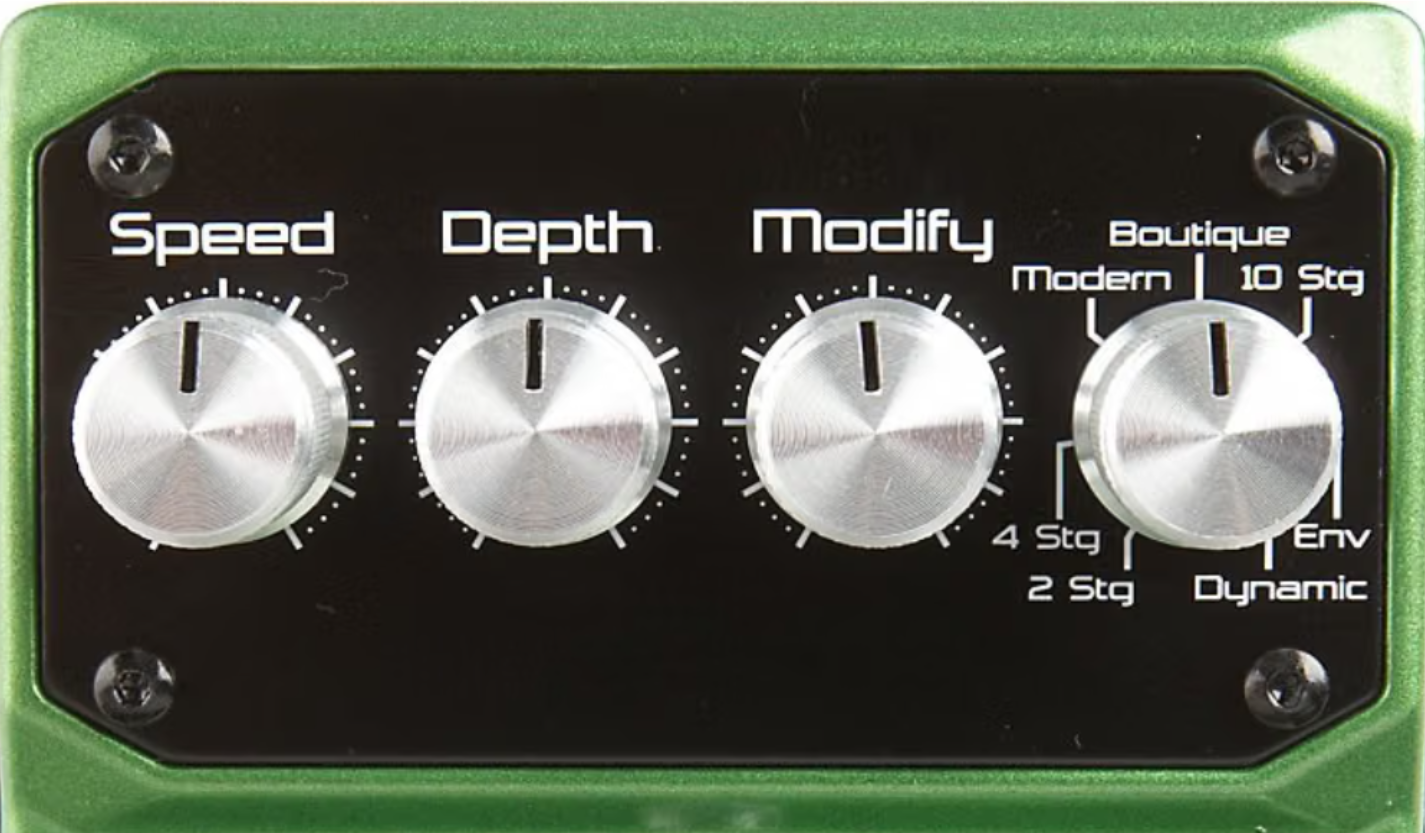
Controls:
- Speed: Controls the speed of the low-frequency oscillator that moves the phase sweep. Turn it counter-clockwise for a slow, wide movement or clockwise for a faster pulse. In Envelope mode, this knob changes jobs and controls the attack time of the triggered sweep.
- Depth: Controls the intensity of the phaser. Lower settings keep the movement tucked underneath your playing, while higher settings make the sweep much more obvious. In Envelope mode it sets the sweep range, and in Dynamic mode it controls the dynamics range.
- Modify: This is the control that gives each mode its extra flexibility. It adjusts bias in 2 Stage mode, feedback in the 4 Stage, Modern, Boutique, and 10 Stage modes, and sensitivity in the Envelope and Dynamic modes.
- Type Selector: Selects one of the SP-7's seven phaser voices:
- 2 Stage: A subtle phase effect with an adjustable bias control. This is the lightest voice in the pedal and a good place to start when you want movement without a deep, hollow sweep.
- 4 Stage: The classic vintage phaser sound. This is the familiar chewy sweep most players expect when they hear the word phaser, with the Modify knob controlling feedback.
- Modern: A deeper 4-stage sound with enhanced feedback and modulation. It has more weight and presence than the vintage-style 4 Stage mode and can get much more dramatic when the Depth and Modify controls are pushed.
- Boutique: A 6-stage phaser with deep feedback control. This one has a thicker, more complex sweep and sits nicely between the classic 4-stage voice and the much deeper 10-stage mode.
- 10 Stage: A modern multi-stage phaser with plenty of control over feedback and depth. This is the wide, dramatic setting for players who want the phase effect to be heard rather than politely hiding behind the guitar.
- Envelope: A triggered phaser that restarts its sweep according to your playing dynamics. Speed becomes Attack Time, Depth becomes Sweep Range, and Modify sets Sensitivity. Once those three controls are balanced for your pickups and playing strength, this mode can get wonderfully funky.
- Dynamic: A touch-responsive phaser in which your playing dynamics control the depth of the effect. Play softly and the phase movement stays restrained. Dig in harder and it becomes more pronounced.
- Footswitch: Press once to turn the effect on or off. Press and hold for three seconds to enter Tap Tempo mode, then tap at least twice to set the modulation speed. Hold it again for three seconds to return the footswitch to normal on/off operation.

Pricing Breakdown:
- Official MSRP: $189.95 (Winter NAMM - January 13 to 16, 2011)
- Typical Street Price: $139.95 (2011 to 2015)
- Discontinued: Late 2015, when DigiTech's parent company (Harman) decided to phase out the entire HardWire sub-brand. They restructured their lineup to put digital effects under the main DigiTech name and analog circuits under a revived DOD brand. While manufacturing officially ceased in 2015, leftover stock continued to filter through retail store channels into early 2016 before completely selling out.
- Documented Clearance Price: Lowest documented discovery so far for a brand new unit is $59.95 during a Musician's Friend Stupid Deal of the Day promotion on January 22, 2015.

Technical info:
- Power: 9V alkaline battery or Harman PS200R 9V DC power supply. The owner's manual lists typical current draw at 75mA, so battery power is best saved for short demonstrations or emergencies.
- Internal Operating Voltage: DigiTech promoted the SP-7 with the HardWire Series' constant high-voltage rails, providing additional headroom while the pedal is powered from a standard 9V supply.
- Specifications: Stereo input and output with Input 1 Mono, Input 2, Output 1 Mono, and Output 2 connections. Input impedance with the effect active is greater than 1 MOhm in stereo operation and greater than 500 kOhm in mono operation. Output impedance with the effect active is 1 kOhm. Dimensions are approximately 5.25 inches long, 3.5 inches wide, and 2.15 inches high. Weight is approximately 1.3 pounds.
- Bypass Type: True HardWire bypass. With the effect off, the signal is routed through a hardwired bypass path. If the battery becomes completely depleted, the pedal automatically switches to bypass.
- Signal Path: Digital stereo phaser with true stereo inputs and outputs. When only Input 1 Mono is used, the processed signal is still available from both outputs. With both inputs connected, the two channels remain separated through the effect.
- Construction: Heavy cast-metal enclosure with the removable HardWire footswitch treadle and battery compartment underneath. It has the same substantial, stage-ready build that made the original HardWire line feel nearly indestructible.
- Included Accessories: Originally shipped with the StompLock™ knob guard, Foot Switch Glow Sticker, hook-and-loop pedalboard pad, owner's manual, and warranty registration information.
- Component Variations: (Needs further research to verify)
- Notable IC chip: (Needs further research to verify)
- Component-side circuitboard image: (On the to-do list)
Heritage: FX20 Phasor  FX20B Stereo Phasor / Phaser FX20C Stereo Phaser XHP Hyper Phase

How players actually use it:
- Classic phaser before overdrive: Put the SP-7 before your overdrive or amp gain and use the 4 Stage mode for that familiar, chewy sweep that moves with the distortion. Keep the feedback under control and it will add motion without taking over the whole sound.
- Cleaner phase after dirt: Move it after overdrive or distortion when you want the phase sweep to stay cleaner and more pronounced. The Modern, Boutique, and 10 Stage modes can sound especially big in this position.
- True stereo spread: Run Output 1 and Output 2 into two amplifiers or two recording channels. The stereo image is much wider than what you hear from a single amp, especially with the deeper modes and slower speeds.
- Touch-sensitive funk: Envelope mode turns short chords, muted rhythm work, and single-note lines into a very playable triggered effect. The trick is setting Sensitivity for your guitar rather than copying someone else's knob position.
- Dynamic lead movement: Dynamic mode lets the effect open up when you dig into a note. It works well for lead playing because the amount of phasing follows your hands instead of sweeping at the same depth all the time.
- Phaser for bass and keyboards: The SP-7's headroom, stereo connections, and wide range make it useful well beyond guitar. Start with less Depth than you think you need, then bring it up until the movement sits properly around the original sound.

Suggested starting settings:
- Classic 4-stage swirl: Type on 4 Stage, Speed around 10 o'clock, Depth around 1 o'clock, and Modify around 10 o'clock. This is the best place to begin if you want the familiar vintage phaser sound.
- Slow boutique sweep: Type on Boutique, Speed around 9 o'clock, Depth around 1 o'clock, and Modify near noon. Big enough to hear clearly, but still easy to use with chords.
- Deep modern movement: Type on Modern, Speed around 10 o'clock, Depth around 2 o'clock, and Modify around 1 o'clock. Try it after overdrive if you want the sweep to stay bold and defined.
- Wide stereo wash: Type on 10 Stage, Speed around 9 o'clock, Depth between noon and 1 o'clock, and Modify around 11 o'clock. Connect both outputs and let the two amplifiers do the rest.
- Envelope funk: Type on Envelope, Attack Time around 11 o'clock, Sweep Range around 1 o'clock, and Sensitivity near noon. Adjust Sensitivity until normal picking reliably triggers the sweep, then fine-tune it for your playing style.
- Touch-responsive phase: Type on Dynamic, Speed around 11 o'clock, Dynamics Range near noon, and Sensitivity near noon. Play softly, then dig in and adjust the two right-hand controls until the effect responds naturally.

Collector notes:
|


