DigiTech HardWire TR-7 Tremolo/Rotary
Home > DigiTech Hardwire Series Pedal Index > DigiTech HardWire TR-7 Tremolo/Rotary

Traditional tremolo, rotary-speaker movement, and vibe
textures give the TR-7 plenty of ground to cover.
The DigiTech HardWire TR-7 Tremolo/Rotary was announced at Summer NAMM in June 2010, adding seven tremolo, rotary, and vibrato effects to the HardWire family. DigiTech already had plenty of experience with modulation, and the TR-7 brought a wide selection of those sounds together in the substantial HardWire enclosure. From a gentle pulse behind clean chords to a much more animated rotary sound, there is a lot to explore here.

What makes the TR-7 interesting is how much variety you get from four knobs. You can start with familiar tremolo, compare the Opto and Bias voices, or experiment with the interacting rhythms in Duo Trem. Then there are the Rotary, Vibe, and VibroPan settings. Add stereo connections, tap tempo, true HardWire bypass, and the series' high-voltage operation, and this little blue pedal can keep you occupied for quite a while.
Okay, let's dive in =)
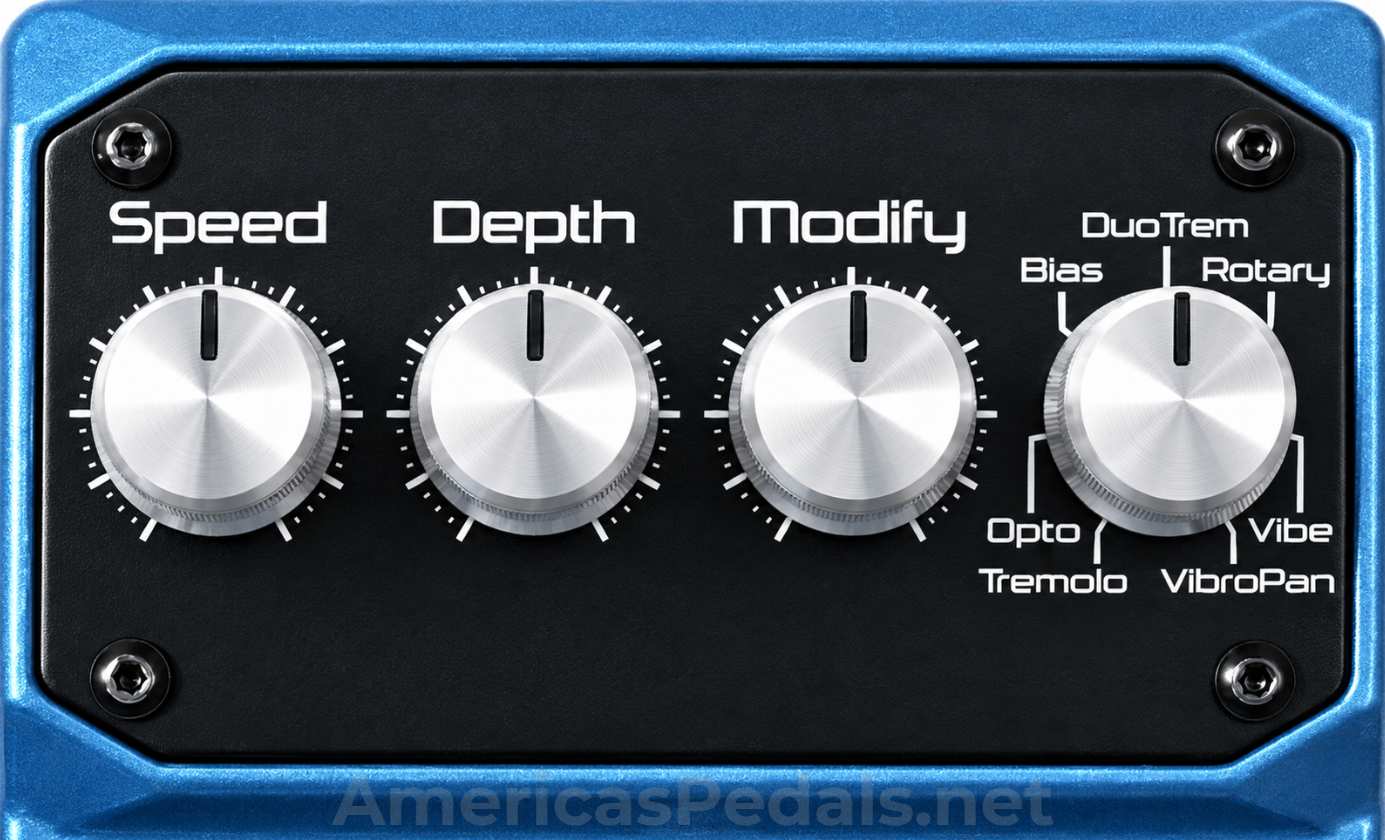
Controls:
- Speed: Sets the modulation rate. Start slowly and bring it up until the movement fits the part you are playing.
- Depth: Sets effect intensity. Keep it modest for accompaniment, then explore deeper settings with sustained chords or single notes.
- Modify: Changes a different parameter in each mode, as described below. Revisit this knob whenever you change the Type setting.
- Type Selector: Selects one of the TR-7's seven effects:
- Tremolo: Volume modulation with adjustable waveform. Modify changes the waveform; try it while repeating a simple rhythm.
- Opto: Vintage Fender-style optical tremolo modeling. Modify adjusts tone. Try this voice first for clean rhythm parts.
- Bias: Vintage Vox-style bias tremolo modeling. Modify adjusts tone. Compare it with Opto using the same guitar phrase.
- Duo Trem: Two tremolos in series. Modify sets the second speed. Hold a chord and explore the interacting pulses.
- Rotary: Leslie-style horn and rotor simulation. Modify adjusts dry level. Leave room between phrases to hear the movement.
- Vibe: Called UltraVibe in the manual. Uni-Vibe-style modulation; Modify moves from chorus at minimum toward vibrato at maximum.
- VibroPan: Two vibrato voices. Modify adjusts their relative phase. Give this setting a turn with both outputs connected.
- Footswitch: Press for on/off. Hold three seconds to enter tap tempo, tap at least twice, then hold three seconds to exit.

Pricing Breakdown:
- Official MSRP: $189.95 (June 2010) Summer NAMM.
- Street Price: $139.95 (2010 to 2015) documented on Guitar Center's retained TR-7 product page.
- Documented Clearance Price: Mostly $99 (2015) ProAudioStar blew out their inventory of TR-7s for $79 bucks but HERE is a documented $59.95 from Musician's Friend January 2015.
- The Aftermarket Sleeper Boom: Here is where the HardWire story gets interesting. The line faded out, bargain deals came along, and years later players were still looking for these pedals. Some of the same models that once needed a discount to get people's attention became the ones people wished they had bought when they had the chance.
It's known as a "Sleeper Boom." The pedal stays the same. Its reputation gets a second life.
- The Myth of the Cheap Multi-Effect:
It is well documented that, during its production run, the HardWire series suffered from a branding problem. In the 2000s and early 2010s, the name "DigiTech" was widely associated with entry-level, plastic multi-effect processors like the RP series.
When DigiTech launched the HardWire line to compete with high-end, boutique brands, that stigma caused many players to ignore them because they were thought of, at the time, to be cheap digital circuits in a metal box. It wasn't until the pedals had been gone for a while that players began taking a closer look and evaluating the audio quality purely on its own merits.
- The Used Market Price Explosion: The pure irony of the "Sleeper Boom" is found in the math. Players who bought a TR-7 for $99 on clearance eventually watched its value drop to as low as $50, then climb past its original day-one retail price. Because their rugged construction makes them nearly indestructible, they became highly reliable for touring players. This caused used prices to steadily rise.
- The reputation has lasted: DigiTech featured the RV-7 in its April 2026 newsletter, describing its continuing cult following and its place on players' pedalboards. That is quite a second act for a discontinued pedal. For the TR-7, the appeal continues to be its combination of useful modulation sounds, stereo connections, and substantial construction.
The paradox we're talking about here is easy to appreciate. A discounted new pedal can eventually cost less than a used one years later. But when checking today's prices, look at completed sales, condition, and included accessories. A seller can ask whatever they like. Finding someone willing to pay it is a different story. =)

Technical info:
- Power: 9V alkaline battery or compatible center-negative DC supply; typical draw 75mA. DigiTech lists PS200R and PS0913DC compatibility.
- Internal Operating Voltage: Elevated internal rails; the exact rail voltage is (Needs further research to verify).
- Specifications: Two inputs and outputs. Active input impedance: greater than 1 MOhm stereo, 500 kOhm mono. Output: 1 kOhm. Dimensions: 5.25 x 3.5 x 2.15 inches. Weight: 1.3 pounds.
- Bypass Type: True HardWire bypass.
- Signal Path: Digital modulation. Rotary sums both inputs before processing.
- Construction: Metal enclosure with a removable footswitch treadle and battery compartment beneath it. Inspect the release pins and battery compartment when checking a used example.
- Included Accessories: StompLock™ knob guard, Foot Switch Glow Sticker, hook-and-loop pedalboard pad, and warranty registration information.
- Notable IC chip: Reported Harman/DigiTech AudioDNA DSP. The RV-7 uses confirmed Lexicon reverb algorithms, but the processor's exact part number and AudioDNA generation still need verification from clear circuitboard photographs.
- Component-side circuitboard image: (On the to-do list)

Heritage:
-
Several branches of modulation history in one pedal:
The TR-7 brings together sounds that originally came from very different pieces of equipment. Its seven modes connect amplifier tremolo, rotating speaker cabinets, and vintage pedal modulation, then add some more adventurous combinations.
- Fender-style optical tremolo: The Opto mode draws on the optical tremolo found in vintage Fender amplifiers, bringing that familiar pulse into a standalone pedal.
- Vox-style bias tremolo: DigiTech describes the Bias mode as an emulation of tremolo produced by varying power-tube bias in vintage Vox amplifiers. The TR-7 recreates that behavior digitally.
- Leslie rotary speakers: Rotary mode models the movement of a cabinet's rotating horn and rotor. That gives this part of the TR-7's heritage a physical starting point: speakers moving through space.
- Uni-Vibe: The Vibe setting, called UltraVibe in the manual, draws on the Uni-Vibe's distinctive modulation. Its Modify control moves between chorus and vibrato textures by changing how much dry signal accompanies the effect.
-
Earlier DOD and DigiTech connections:
The DOD FX22 Vibro Thang was an earlier attempt to put rotary-like movement into a compact stompbox. Its manual specifically described the added phasing as producing dimension and color reminiscent of a rotary speaker.
DigiTech's XP-200 Modulator also explored tremolo, vibrato, and automatic panning in a single digital pedal. Its 1997 manual documents stereo outputs and expression-pedal control, showing that spatial modulation was already part of DigiTech's vocabulary well before the HardWire series.
These are useful historical connections rather than a verified shared circuit or software lineage. The TR-7 gathers related ideas into the HardWire format, with dedicated knobs, stereo connections, and tap tempo. Duo Trem and VibroPan extend that story through interacting tremolos and paired vibrato voices.
-
Documentation:
TR-7 Owner's Manual
|
XP-200 Owner's Guide (1997)

How players actually use it:
- Clean tremolo behind rhythm guitar: Start with Opto and keep the Depth modest. Play the actual rhythm part while adjusting Speed. A setting that sounds impressive on one held chord may be too busy once you start playing the song.
- A pronounced pulse after overdrive: Try the TR-7 after your dirt pedals when you want the tremolo to remain clear. Compare it before the drive as well, since compression and distortion can change how strongly the pulse comes through.
- Vibe before drive: Put Vibe ahead of a moderate overdrive and start with the Modify knob at the chorus end of its range. Keep the gain low enough to hear your adjustments, then bring it up to suit the part.
- Rotary for sustained chords: Give the notes some breathing room. Try a slow Speed setting first, then explore faster movement. Adjust Modify while listening to the whole part rather than judging the sound from a single note.
- Unusual rhythms with Duo Trem: Hold a chord while slowly adjusting Modify, then try playing along with a pattern you like. This mode rewards a little patience. You may stumble onto a rhythm you would never have dialed in deliberately.
- Two-amplifier experiments: Compare Rotary and VibroPan through two amplifiers or recording channels. If you are recording, also listen to the result in mono so you know how the part translates.

Suggested starting settings:
- Easy clean tremolo: Type on Opto, Speed around 10 o'clock, Depth around 11 o'clock, and Modify near noon. Adjust the speed to fit your rhythm before adding more Depth.
- Stronger tremolo pulse: Type on Tremolo, Speed near noon, Depth around 2 o'clock, and Modify near noon. Explore the waveform control while repeating a short chord pattern.
- Slow rotary movement: Type on Rotary, Speed around 9 o'clock, Depth near noon, and Modify near noon. Fine-tune the dry level to suit the arrangement.
- Vibe with overdrive: Type on Vibe, Speed around 10 o'clock, Depth near noon, and Modify fully counter-clockwise. Try it before a moderate overdrive and adjust from there.
- Vibrato exploration: Type on Vibe, Speed around 10 o'clock, Depth around 11 o'clock, and Modify fully clockwise. Start gently and bring up Depth only as much as the part needs.
- Interacting tremolo rhythms: Type on Duo Trem, Speed around 10 o'clock, Depth near noon, and Modify around 1 o'clock. Slowly adjust Modify while sustaining a chord, then play along with the pattern.
These are suggested starting points, not factory presets. Your guitar, amplifier, and playing style get the final vote.

Collector notes:
- The TR-7's history starts with the June 2010 Summer NAMM announcement. HARMAN planned August 2010 availability and promoted the pedal again at Winter NAMM in January 2011. The planned availability date does not establish the exact first shipment date.
- Look for the box, paperwork, StompLock™, glow sticker, and pedalboard pad when checking an example described as complete. Ask for pictures of the actual contents so you know what is included.
- Test every Type position, all three parameter knobs, both inputs, both outputs, bypass, and tap tempo. A demonstration of one tremolo setting leaves much of the pedal unchecked.
- Check the battery compartment for corrosion, inspect the battery clip, and make sure the treadle sits securely on its release pins. Clear underside photographs can tell you things a clean front view will not.
- Factory footswitch branding variations feature both HardWire and DigiTech, with the Digitech version seemingly harder to find. Since the treadle is removable, its logo alone should not be used to establish a pedal's production date or originality.

Known quirks and tips:
- Tap tempo uses subdivisions: one-second taps give 4Hz in the tremolo modes and 2Hz in Rotary, Vibe, and VibroPan.
- Practice the tap-tempo footwork before using it during a song. Give yourself time to enter the mode, hear the result, and make another adjustment if needed.
- When comparing modes, use the same short phrase and keep your amplifier settings steady. It makes the differences much easier to judge.
- Set tremolo Depth at the volume you actually play. A deep setting that sounds great alone may need adjustment once bass, drums, and another guitar join in.
- Try different pedal positions before settling on one. A useful location for tremolo may give you a different result with Vibe, so choose the position that best serves the sounds you use most.
- Do not judge a used pedal from its appearance alone. Spend a few minutes with the less familiar modes and the second output before deciding everything works properly.

Hear the DigiTech HardWire TR-7 Tremolo/Rotary in action:
External Links:
Home  America's Pedal
FX-Series
X-Series
D-Series
Artist Series
Performer Series
Hardwire Series
Specialty Pedals
New Releases
Field Guide
Serial Number info
FX literature
What's New?
FX Tech info
Links
Disclaimer/Legal/Contact Us
|