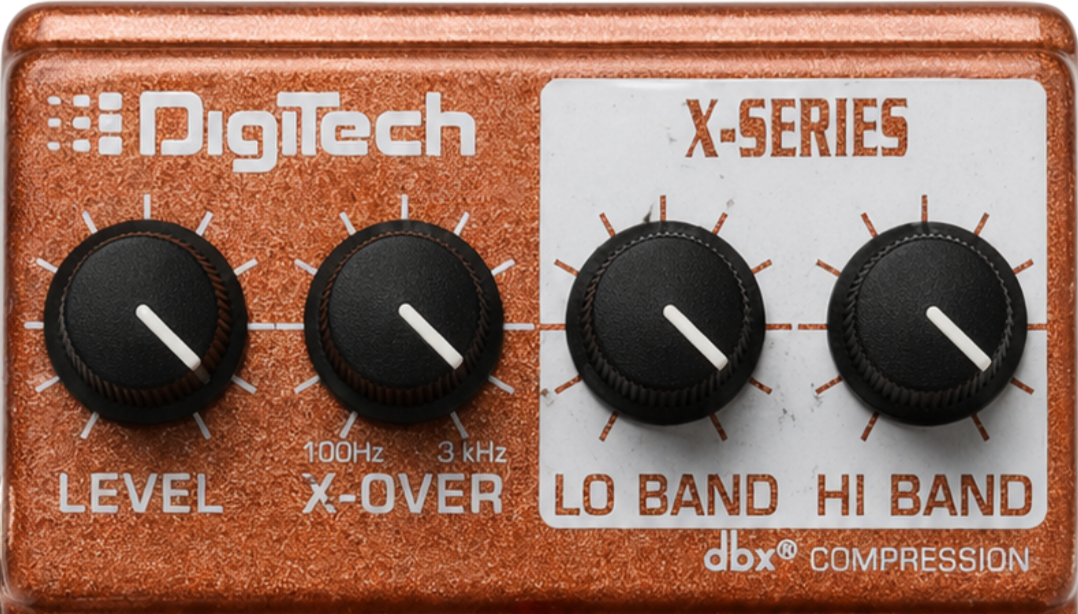
The DigiTech XBS Bass Squeeze is one of the smartest bass pedals in the X-Series lineup, and it is also one of the easiest to underestimate if you only look at it for a few seconds. A lot of compressor pedals promise to even things out, add sustain, and make your playing feel more polished. The Bass Squeeze goes further than that. It gives bass players dual-band compression in a stompbox, with dbx compression technology sitting right there on the face of the pedal like a little badge of studio credibility.
That is the part that matters. This was not just DigiTech putting the word "bass" on a regular compressor and calling it a day. The XBS was built around a real bass problem. Low frequencies and high frequencies do not always need the same treatment. A low E string can jump out and overload a mix while the upper harmonics still need to breathe. Slap attack can need control up top while the bottom needs to stay big and steady. The Bass Squeeze lets you split the job into two zones and work on each one separately. For a compact early 2000s pedal, that was a pretty serious idea.
Released during DigiTech's X-Series run, the XBS sits with the other bass-specific models as proof that DigiTech was giving bass players more than leftovers from the guitar side of the catalog. This one was about control, polish, and feel. Not flashy control. Useful control. The kind that makes the bass sit better in a mix without making it sound like somebody threw a blanket over the amp.
From the manual:"The Bass Squeeze Compressor is a studio quality, dual-band compressor for bass guitar. Featuring dbx® dynamics processing courtesy of DigiTech’s AudioDNA™ DSP engine, the Bass Squeeze provides the versatility you will need for a variety of applications. Whether you are mildly compressing the lows and highs, or doing radical tone shaping, you will find that the Bass Squeeze will be an indispensible part of your rig."
Now, let's get into it =)
Controls:
Level: Sets the overall output volume of the pedal. This is where you bring the compressed signal back up to unity gain, or push it a little if you want the bass to feel more present. With compressors, this control matters because compression can change perceived volume even when the actual signal level looks close.
X-Over: Sets the crossover point between the low band and high band compression sections. The range is marked from 100Hz to 3kHz, which gives you a lot of room to decide what the pedal treats as the low-frequency body of the bass and what it treats as upper attack, detail, and string character. This is the heart of the pedal right here.
Lo Band: Controls the amount of compression applied to the lower frequency band. Use this to tighten up big low notes, smooth out uneven string response, and keep the bottom end from jumping all over the place. Too much can make the bass feel squashed, but the right amount can make the entire rig feel more expensive.
Hi Band: Controls the amount of compression applied to the higher frequency band. This is where you tame slap pops, finger noise, pick attack, and upper-mid bite without necessarily crushing the deep lows. It is especially useful when the bass needs to stay articulate but not poke holes in the mix.
List price: $119.95 (sold for $79.95 to $99.95 at major retailers)
Technical info:
Circuitry: Digital dual-band bass compressor pedal using dbx compression technology
Construction: Heavy-duty metal housing
Dimensions:
Length: 4 15/16 inches (approx. 125 mm)
Width: 3 1/8 inches (approx. 79 mm)
Height: 2 1/8 inches (approx. 54 mm)
Weight: 1.38 lbs (approx. 0.63 kg)
Input Impedance: 1 MOhms
Output Impedance: 100 Ohms
Power Supply: 9V battery or DigiTech PS200R 9V DC adapter
Battery Life: Approximately 4 hours continuous use
Notable IC chip: AudioDNA1 DSP processor
Special feature: Dual outputs for amp and mixer use
Component-side circuitboard image: (On the to-do list)
Now, here is where this one gets really interesting...
Compression is one of those effects that bass players either love, misunderstand, or quietly depend on without wanting to admit it. The funny thing is, when compression is done right, you do not always notice the effect. You notice that the bass feels better. The notes sit more evenly. The amp behaves. The mix tightens up. Nobody in the audience says, "Wow, great compression." They just feel the band hit harder.
The XBS Bass Squeeze is important because DigiTech did not approach compression as a simple squash box. They gave bass players a dual-band design. That means the pedal can treat the low end and high end differently, which makes perfect sense for bass. The low part of the signal carries the weight. The high part carries the finger attack, pick click, string sound, slap pop, and definition. Those two parts of the same note often need different handling.
That is why the X-Over control is so important. It is not just another knob to make the pedal look more advanced. It decides where the low band hands off to the high band. Set it lower, and more of the note lives in the high-band section. Set it higher, and more of the bass's core tone gets handled by the low-band compressor. Once you understand that, the pedal becomes much easier to dial in.
The dbx connection also gives this pedal a special place in the X-Series story. dbx had a long reputation in studio and live sound compression, so seeing that name on a DigiTech stompbox was not a small thing. It positioned the Bass Squeeze as something a little more serious than the average compact compressor. It was a pedalboard-friendly way to bring a studio-style concept to players who may never have owned a rack compressor or studio processor.
And that is the whole charm of this pedal. It does not look like a monster. It does not scream for attention. But once you start using it the way it was designed to be used, it makes a lot of sense. It is not about making the bass sound "effected." It is about making the bass behave, breathe, punch, and sit where it belongs.
That may not sound glamorous, but ask any working bass player. That is the kind of thing that saves the gig.
Press the Play Button below to hear the original DigiTech Bass Squeeze Sound Demo (2003)
How players actually use it:
Evening out fingerstyle playing: This is probably the most natural use for the XBS. It helps smooth out uneven note levels without making the bass feel lifeless. A good setting can make your right hand sound more consistent than it really is, and I say that with great respect for all of us who have right hands with opinions.
Keeping slap under control: Slap bass can be a compression nightmare because the low notes and popped strings behave so differently. The dual-band setup lets you control the thumbed lows and the popping highs separately, which is exactly why this pedal makes sense.
Tightening up active basses: Active basses can hit a rig hard, especially with boosted lows or bright onboard EQ. The XBS can help keep that signal civilized before it gets to the amp.
Adding polish for direct recording: The mixer output makes this pedal useful for quick direct recording or simple live setups. It is not a full studio channel strip, but it can absolutely help a bass track feel more controlled going in.
Always-on bass control: Some players will use the Bass Squeeze less as an "effect" and more as part of the instrument's voice. Once it is set correctly, you just leave it on and let it do its job.
Smoothing pick attack: Pick players can use the Hi Band control to tame sharp attack while keeping the low band full and solid. That is especially useful when the bass needs to cut through guitars without sounding brittle.
Balancing old and new basses: If you switch between instruments, the XBS can help level the playing field a little. It will not make two basses identical, but it can help keep the output and feel from changing too wildly.
Live mix support: In a band setting, compression often matters more than it does in the bedroom. The XBS helps the bass stay present without requiring the sound person to chase every note.
Suggested starting settings:
Natural fingerstyle compression: Level at unity, X-Over around noon, Lo Band at about 10 to 11 o'clock, Hi Band around 10 o'clock. This keeps the pedal subtle and musical instead of obvious.
Slap control setting: X-Over slightly higher, Lo Band around noon, Hi Band around 1 to 2 o'clock. This helps control the popped notes while keeping the lows firm.
Big low-end stabilizer: X-Over around 10 to 11 o'clock, Lo Band around 1 o'clock, Hi Band lower. This is useful when the bottom end is jumping around too much and needs a little discipline.
Pick attack smoother: X-Over around noon, Lo Band light, Hi Band around 1 o'clock. This keeps the pick definition but takes the sharp edge off the top.
Direct recording helper: Level matched carefully, X-Over around noon, both bands moderately compressed. The goal is not to crush the sound. The goal is to make the bass sit in the track before the track starts arguing with you.
The Bass Squeeze is one of those pedals that makes more sense the longer you live with it. It is not a pedal that walks into the room wearing sunglasses and asking everybody to look at it. It is more like the quiet studio guy in the corner who knows how to make the whole band sound better. That is a very different kind of cool.
Collector notes:
The XBS Bass Squeeze is one of the four dedicated bass pedals in the DigiTech X-Series family, and that alone gives it a special place in the collection.
Bass-specific X-Series pedals do not seem to show up quite as often as the guitar models. That makes clean examples worth paying attention to, especially with the original box and paperwork.
The dbx Compression marking on the faceplate is a big part of this pedal's identity. It separates the XBS from generic bass compressors and ties it to a much larger studio/live sound heritage.
The copper-orange X-Series finish looks great on this model, but wear around the edges, knob area, and label panel is common. These pedals were usually bought to be used, not tucked away in display cases.
The black treadle pad is important. Like the rest of the X-Series, this pedal used the dark DigiTech treadle design, not a silver footswitch or anything like that.
Collectors building a complete X-Series run should not overlook this one. The guitar pedals may get more attention, but the bass pedals tell an important part of the DigiTech story.
Complete examples with the manual, box, and inserts help document the pedal more fully, especially because the bass side of the X-Series has not been covered nearly as much as the guitar side.
Known quirks and tips:
The X-Over knob is the one that can confuse people at first. If the pedal feels like it is not responding the way you expect, do not immediately blame the Lo Band or Hi Band controls. Move the crossover point and listen to how the whole pedal changes.
Too much low-band compression can make the bass feel smaller even though the sound may seem more controlled. That is the classic compressor trap. The goal is to tighten the lows, not put them in a headlock.
Too much high-band compression can make the attack feel dull or overly polite. That can be useful in some mixes, but if the bass disappears, back it down.
Active basses may hit the pedal harder than passive basses. If the sound feels too clamped down, reduce the bass's onboard output or EQ slightly before changing every knob on the pedal.
Compression is easiest to judge in context. A setting that sounds almost too subtle alone may be perfect with drums and guitars. That is where this pedal earns its keep.
Like the other X-Series pedals, battery life is not the reason to own it. Use the proper power supply if this one is going on a board.
The dual outputs make it more flexible than it first appears. Running one output to an amp and the other to a mixer or recording path gives the pedal more practical use than a standard single-output compressor.
What I like about the XBS is that it is not trying to be the most dramatic pedal on the board. It is trying to make the bass work better. That is a different kind of mission, but it is an important one.
The Bass Squeeze shows DigiTech thinking like musicians and engineers at the same time. Give the player control over the low end. Give them control over the top. Let them decide where those worlds meet. Add dbx compression into the story, put it in a rugged X-Series box, and you end up with a pedal that deserves more respect than it usually gets.
To me, that is what makes this one special. It is not just another compressor. It is a very early 2000s DigiTech answer to a real bass player's problem, and it still makes a lot of sense today. -Ron