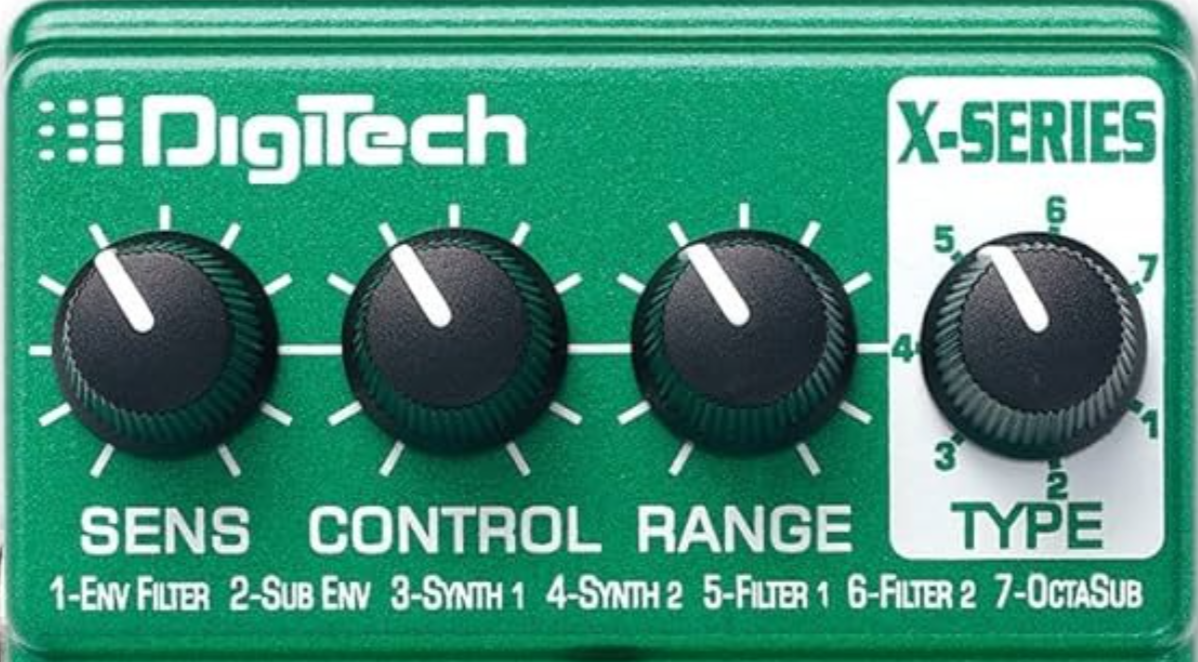
The DigiTech XBW Bass Synth Wah is one of the most entertaining pedals in the entire X-Series line because it does not think like a normal bass stompbox. This one was built for movement, attitude, and that wonderful moment when a bass line stops acting like support and starts acting like the hook. DigiTech gave bass players a box that could cover classic envelope-filter quack, deeper synth textures, and even octave-shifted weirdness, all in one pedal that still looked perfectly at home beside the rest of the X-Series family.
That is really why the XBW has hung around as a cult favorite. It is not just a wah. It is not just a filter. It is not just a synth pedal. It sits right in the middle of all three worlds and lets the player decide how far to lean into the madness. If you are chasing Bootsy-style funk, talky filter textures, or that early-2000s "how did they get that bass sound?" territory, this pedal absolutely understands the assignment.
From the manual:"The Bass Synth Wah is an exciting combination of seven different synth and wah effects including envelope filter, synth tones, filter generators, and octave shift. The Bass Synth Wah can be run inline with your current pedals, or parallel with your bass tone to create unique combinations of both bass and synth sounds.
Now, let's get into it =)
Controls:
Sens: Controls how easily the effect triggers from your playing attack. Turn it up and the pedal reacts faster to a lighter touch. Back it down and you will have to dig in harder before the filter or synth sweep really starts talking.
Control: This knob changes jobs depending on the selected effect type. On some settings it adjusts the wet/dry relationship, on others it governs synth attack or filter attack. In other words, this is one of those knobs that rewards a little time and curiosity.
Range: Like the Control knob, this one changes function depending on the chosen mode. It can set sweep range, cutoff frequency, envelope behavior, or synth mix, so it is a huge part of how the XBW moves from funky to downright outer space.
Type:
Env Filter: This is your classic envelope filter sound. It responds directly to your picking dynamics, opening up into that familiar quack when you dig in and closing down when you play softer. Think traditional funk bass tones, but with a little more modern DigiTech polish behind it.
Sub Env: Takes the envelope filter concept and adds a sub-octave underneath your note. You still get the expressive filter sweep, but now there is extra low-end weight following it. This one can get huge fast, especially if you are already running a strong bass signal.
Synth 1: A monophonic synth-style voice with a smoother, more rounded character. It tracks your playing and reshapes it into something closer to an analog synth line. The attack can feel slightly softer, which makes it great for lines that need to bloom rather than snap.
Synth 2: A more aggressive and immediate synth voice compared to Synth 1. It has a sharper attack and a bit more edge, making it better for parts that need to cut through a mix or feel more electronic and forward.
Filter 1: This is where things start getting a little more vocal. Instead of a simple up-and-down envelope sweep, Filter 1 introduces a more complex, formant-like character. It can sound almost like the pedal is trying to "talk" back to you, especially when dialed in carefully.
Filter 2: Similar idea to Filter 1, but with a different tonal emphasis and response curve. It leans into a more pronounced, sometimes sharper filtering effect that can get a little more experimental. Great for textures that need to stand out instead of sit politely in the background.
OctaSub: Adds a synthesized octave-down voice beneath your note, with control over how much of that sub signal blends in. This is less about movement and more about sheer depth. Used right, it can make a single-note bass line feel massive without losing definition.
List price: $129.95 (typically retailed for between $79.95 and $89.95)
Technical info:
Circuitry: Digital bass envelope filter and synth effect pedal
Construction: Heavy-duty metal housing
Dimensions:
Length: 4 15/16 inches (approx. 125 mm)
Width: 3 1/8 inches (approx. 79 mm)
Height: 2 1/8 inches (approx. 54 mm)
Weight: 1.38 lbs.
Input Impedance: 1 MOhms
Output Impedance: 100 Ohms
Power Supply: 9V alkaline battery or DigiTech PS200R 9V DC adapter
Power Consumption: 4.8 Watts (with optional PS200R power supply)
Battery Life: Approximately 4 hours continuous use
Special feature: Dual-output dry/effect routing plus built-in CIT cabinet modeling for direct bass applications
And this is where the XBW really starts to separate itself from the pack...
Most bass pedals are trying to preserve, enhance, or slightly reshape your core tone. The XBW is more adventurous than that. It invites you to split your dry and effected signals, treat the synth voice like a second instrument, and build tones that are part bass rig and part keyboard rig. That is a very DigiTech idea, and it fits the X-Series era perfectly.
The dual-output setup is a big clue. When you run just the main output, the XBW behaves like a more traditional pedal. But the moment you use both outputs, you can send dry bass to one destination and effect-only signal to another. That opens up some very cool real-world possibilities. One amp can hold the foundation while the other carries all the squawk, wobble, and synth nonsense. For bass players who hate losing their low-end anchor, that is not a gimmick. That is smart design.
The seven Type settings are also a big part of the appeal. Classic envelope filter tones are only the beginning. Sub Env adds octave-down weight. Synth 1 and Synth 2 push into monophonic synth territory with different envelope behaviors. Filter 1 and Filter 2 take DigiTech's Synth Talk-style approach into bass land. OctaSub gives you a pitch-shifted low voice with variable synth blend. In other words, this thing was built for players who liked to experiment but still wanted a pedal, not a rack unit or a menu-diving nightmare.
That is why the XBW feels more important the longer you spend with it. It captures an era when DigiTech was giving bass players some genuinely imaginative tools instead of just repainting guitar ideas and hoping nobody noticed. The XBW is one of the clearest examples of that whole philosophy.
Press the Play Button below to hear the original DigiTech Bass Synth Wah Sound Demo (2003)
How players actually use it:
Classic funk envelope lines: The most obvious use, and still one of the best. Set it for a quick, expressive sweep and it gets into that rubbery, vocal, instantly addictive funk territory that makes simple bass parts feel alive.
Synth-bass hooks: This is where a lot of people really fall for it. Use Synth 1 or Synth 2 and the XBW starts acting less like a pedal and more like a tiny bass synth with attitude.
Parallel live rigs: Send dry signal to one amp and effect-only signal to another or to the PA. The XBW was practically begging to be used this way, and it is one of the smartest ways to keep your low-end solid while still getting gloriously weird on top.
Octave-heavy electronic textures: OctaSub can give you that huge, chewy, synthetic push that works beautifully for modern grooves, industrial-leaning bass parts, or anything where the low end needs to sound slightly dangerous.
Talky filter effects: Filter 1 and Filter 2 can get into that vocal, almost talking kind of response that makes the line feel like it is saying something back to the listener.
Studio color box: Even if it never lives on a main pedalboard, the XBW makes a lot of sense as a recording pedal. It can take one otherwise ordinary overdub and turn it into the part everyone remembers.
Guitar side missions: Even though it was made for bass, adventurous guitarists have absolutely found fun in it too. It is not the "correct" use, which is exactly why some people love it.
Suggested starting settings:
Bootsy-ish fun: Env Filter, Sens around mid to upper range, Control favoring a healthy effect blend, Range adjusted so the sweep opens quickly without getting too shrill. Great for touch-sensitive funk lines.
Slow synth bloom: Synth 1, moderate Sens, slower attack from the Control knob, and Range adjusted for a fuller, darker response. This is a nice one when you want the note to swell into the effect instead of just popping out at people.
Aggressive talking bass: Filter 1 or Filter 2, Sens set high enough to respond consistently, then work Control and Range until the effect starts to sound almost vocal. It gets weird fast, in a good way.
Sub-heavy electronic groove: OctaSub, Sens matched to your playing strength, Sub Level and synth mix balanced so the effect sounds huge without completely swallowing note definition.
Parallel rig sweet spot: Run Out 1 to your normal bass amp and Out 2 to a second amp or mixer channel. Keep the dry side steady, then get as bold as you want on the effect side. This is one of the smartest ways to use the pedal.
The more you think about it, the more the XBW feels like one of DigiTech's most unapologetically creative bass pedals. It was not trying to be subtle. It was trying to give bass players movement, character, and a reason to step out of the usual lanes. That is a big part of why it still has real personality today.
Collector notes:
The XBW Bass Synth Wah has become one of the more memorable niche pieces in the X-Series family because it does something very different from the usual bass pedal categories.
It appeals to both bass collectors and synth-curious pedal people, which gives it a broader kind of charm than you might expect from a specialized model.
Clean examples with box and paperwork are always more interesting, especially since many of these were bought to be played hard instead of tucked away.
The Bass Synth Wah also helps tell the bigger story of what DigiTech was doing in the early 2000s. They were not just making safer versions of old effects. They were trying to hand players more sound design in a stompbox format.
As X-Series collecting grows, the bass models matter more because they round out the family and prove DigiTech was thinking beyond the standard guitar crowd.
This is exactly the kind of pedal that casual flippers may not fully appreciate, but players who understand what it can do tend to remember it.
Known quirks and tips:
The manual recommends putting the XBW first in the effects chain whenever possible. That is not random advice. The triggering behaves better when the pedal sees the cleanest signal it can.
Small changes to Sens can make a very noticeable difference, especially if you switch between fingerstyle, pick playing, and slap. This is one of those pedals that reacts to the player more than people sometimes expect.
The two-output setup is a gift if you use it, and wasted potential if you ignore it. Running dry and effect separately is one of the things that makes this pedal far more flexible than it first appears.
CIT cabinet modeling has to be enabled each time power is applied, so like the other X-Series pedals with CIT, it is best thought of as a useful option rather than a permanent global setting.
Some settings get wild fast. That is not a flaw. It is part of the charm. The trick is to dial it in with the band or track in mind, not just while noodling alone in the room.
What I like about the XBW is that it feels like DigiTech gave bass players permission to be a little less polite. This is not just a utility pedal. It is a personality pedal. It can still do the practical job of keeping the bass relevant and big, but it can also turn the line into something theatrical, vocal, and memorable.
That is why this one matters to me. The XBW is one of those pedals that reminds you the bass does not always have to sit quietly in the back of the room. Sometimes it gets to be the weirdest and most interesting thing in the song. -Ron