The DigiTech XBD Bass Driver is one of the more interesting sleepers in the X-Series lineup because it was built to solve a very specific problem. Bass players have always loved dirt, but they have also spent decades fighting the downside of it. A lot of overdrive and distortion pedals sound exciting for about ten seconds, then the band kicks in and all the weight disappears. DigiTech clearly understood that. Instead of treating the bass like a guitar with thicker strings, the XBD was designed from the ground up to keep the low end present while still giving players access to multiple flavors of driven tone.
Released during DigiTech's early 2000s X-Series run, the XBD used the company's AudioDNA DSP platform to model three classic distortion circuit styles in one stompbox. That is a pretty big part of what makes it special. This was not just a one-trick bass fuzz or a generic "drive" pedal with a bass label slapped on the box. It was DigiTech taking what they were already doing with pedals like the Tone Driver and Metal Master, then rethinking the whole concept for bass players who needed grit, punch, and clarity to live together in the same pedal.
From the manual:"The Bass Driver Distortion is the world's most advanced overdrive pedal designed specifically for bass. DigiTech's exclusive AudioDNA™ technology is what makes the Bass Driver more than a standard overdrive stompbox. Rather than working with a single distortion circuit, the Bass Driver features a Morph knob that blends three totally distinct overdrive and distortion types. You now get a wide variety of overdrive sounds that can be dialed in quickly and easily."
Now, let's get into it =)
Controls:
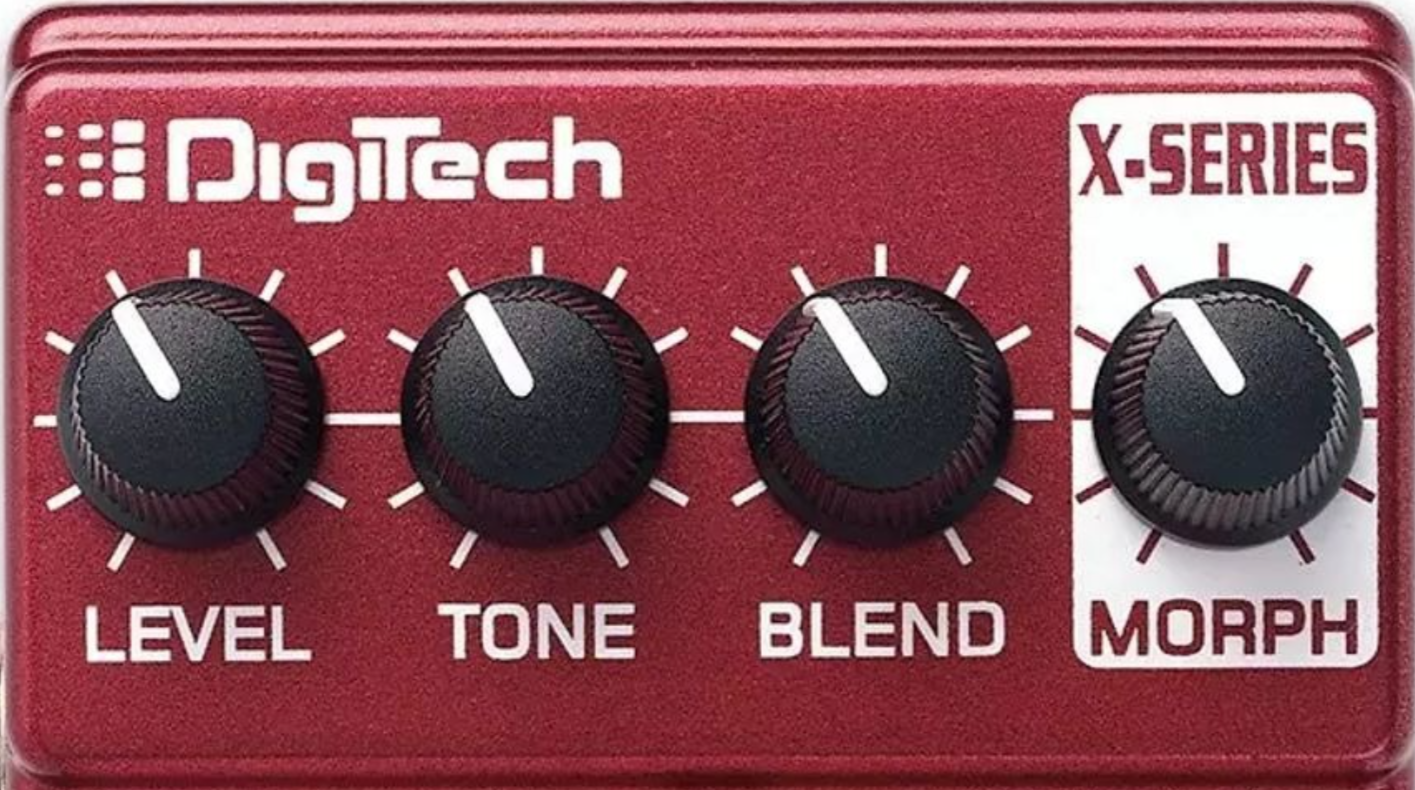
Level: Sets the overall output volume of the pedal. This is where you match unity with your clean tone or push the front end of your amp a little harder when you want the bass to step forward in the mix.
Tone: A single, wide-range tone control that shapes the overall brightness of the effect. Turn it clockwise for more bite and presence, or roll it back to smooth out the top end and keep things warmer and rounder.
Blend: This is one of the most important controls on the entire pedal. It mixes your clean bass signal with the distorted signal. Lower settings keep more of your original tone intact, while higher settings push the effect forward. This is exactly how the XBD avoids the classic "lost low end" problem that kills a lot of bass distortion pedals.
Morph: Adjusts the character and response of the selected distortion model. Think of it as a fine-tuning control that reshapes how the drive behaves, from tighter and more controlled to looser and more aggressive depending on where it is set.
List price: $79.95
Technical info:
Circuitry: Digital bass distortion modeling pedal
Construction: Heavy-duty metal housing
Dimensions:
Length: 4 15/16 inches (approx. 125 mm)
Width: 3 1/8 inches (approx. 79 mm)
Height: 2 1/8 inches (approx. 54 mm)
Weight: 1.38 lbs (approx. 0.63 kg)
Input Impedance: 1 MOhms
Output Impedance: 100 Ohms
Power Supply: 9V battery or DigiTech PS200R 9V DC adapter
Battery Life: Approximately 4 hours continuous use
Notable IC chip: AudioDNA DSP processor
Special feature: Built-in CIT cabinet modeling for direct use into a mixer or recorder
Component-side circuitboard image: (On the to-do list)
Now, here is where this one gets really interesting...
The XBD Bass Driver lands right at that point where DigiTech was no longer just making pedals that copied old categories. They were starting to reinterpret them. That is the bigger story here.
Earlier bass dirt boxes were usually pretty straightforward. You got one core voice, maybe some EQ, and then you either liked what it did to your rig or you did not. The XBD takes a different approach. DigiTech gives you three modeled drive families in one enclosure, then hands you separate low and high EQ plus the Morph control so you can steer the pedal toward the bass, amp, and playing style in front of you. That may not sound revolutionary now, but for an early 2000s bass stompbox, that was a pretty forward-looking move.
And really, that is the whole X-Series mindset in a nutshell. More flexibility. More DSP. More tonal territory in one box. The XBD may not get talked about as much as some of the guitar models, but it is a very clear example of DigiTech applying that philosophy to bass players who needed options without having to drag a rack unit to the gig.
You can also feel the transition from old DOD-style bass dirt into newer DigiTech-style modeling here. The DOD FX91 Bass Overdrive and similar units were still rooted in the more traditional pedal way of thinking. The XBD moves the conversation forward. It is less about one fixed analog voice and more about giving the player multiple usable gain structures that can be shaped for the room, the rig, and the song.
That is probably why the XBD makes more sense the longer you sit with it. On the surface it looks like just another niche X-Series model. Once you really think about what it was trying to do, it becomes a lot more important. It is one of DigiTech's clearer statements that bass players deserved the same level of experimentation and tonal flexibility guitar players were getting.
That also explains why players who understand bass tone tend to appreciate this pedal more than casual flippers do.
Press the Play Button below to hear the original DigiTech Bass Driver Sound Demo (2003)
How players actually use it:
Low-end-preserving grind: This is probably the most natural use for it. Dial in just enough gain to add hair and authority without losing the foundation of the note.
Pick-style rock bass: With the highs brought up a bit and the gain set to medium, the XBD can deliver that biting, clanky edge that helps a pick attack jump out of a dense mix.
Parallel-style feel without a blend knob: It does not literally have a clean blend control, but smart use of the Low EQ and Morph knob can get you into that same neighborhood where the bass still feels anchored underneath the dirt.
Aggressive modern bass tones: Push the gain, tighten the lows a little, and the XBD can get into more contemporary hard rock and metal territory without totally dissolving into fizz.
Fuzz for bass lines that need personality: The fuzz mode is where this pedal gets more unruly and more fun. It is especially useful when you want a bass line to sound like part of the hook instead of just part of the support structure.
Direct recording experiments: CIT gives it another angle. This is one of those pedals that can actually make sense when you are going direct, especially for quick demos and layered recording ideas.
Live board problem solver: For players covering a lot of material, having three basic families of bass dirt in one pedal is genuinely useful. One box, several jobs.
Studio layering: It also works nicely for double-tracked bass parts where one track holds the fundamental and the other track carries more edge and texture.
Suggested starting settings:
Warm bass overdrive: Overdrive mode, gain low to medium, lows slightly boosted, highs just above flat, Morph around noon. This gives you a more natural push without making the pedal sound like it is trying too hard.
Cut-through rock tone: Distortion mode, gain around halfway, lows kept firm but controlled, highs boosted enough to define the attack. Great for pick bass and punchier rock arrangements.
Hairy fuzz bass: Fuzz mode, gain higher, lows supported, highs adjusted carefully so the top end stays exciting instead of brittle. This is the one where a little restraint can save you a lot of speaker-flapping chaos.
Subtle always-on edge: Overdrive mode, lower gain, Level just above unity, EQ nearly flat. This is a smart setting if you mainly want the pedal to make the bass feel more alive and a little more serious.
A pedal like this tells a bigger story than people realize. The XBD is one of those pieces that shows DigiTech was paying attention to bass players during the X-Series era, not just tossing them a token model and calling it a day. Whether you use it gently or crank it into full-on filth, it is obvious this pedal was meant to be worked with, not just admired in a catalog.
Collector notes:
The XBD Bass Driver is one of the more overlooked X-Series pedals, and that is part of what makes it interesting now. People chasing the guitar models often walk right past it.
Bass-specific pedals usually sold in lower numbers than the broader guitar-market units, so you do not see these quite as often in the wild.
Most surviving examples were bought to be used, not shelved. So when one turns up clean, complete, and with the box, that gets more interesting fast.
The XBD also represents a very specific early 2000s DigiTech design idea: take DSP seriously, give the player options, and do not apologize for being a little more advanced than people expected from a stompbox.
As complete X-Series collecting becomes more of a thing, the bass pedals are the exact kind of pieces that start looking more important because they round out the story instead of just repeating it.
It is also a nice reminder that some of the best pedals in a family are not always the loudest or the most hyped. Sometimes they are the ones that solved a real-world problem in a thoughtful way.
Known quirks and tips:
The Morph control is one of the keys to the whole pedal. Small adjustments can make a bigger difference than you might expect, so it is worth taking your time with it.
If you pile on too much gain and too much bass at the same time, things can get cloudy in a hurry. This is not really a flaw, just a friendly reminder that bass distortion always needs a little discipline.
CIT has to be enabled at power-up each time, so like the other X-Series pedals with this feature, it is more of a handy option than a set-it-and-forget-it mode.
Active basses can hit the front end harder, which is sometimes great and sometimes a little too much. Backing off the instrument volume just a touch can clean things up nicely.
The XBD tends to reward players who dial with their ears in the full mix rather than soloed in the room. What sounds almost too controlled alone often sounds exactly right once the drums and guitars show up.
What I like about the XBD is that it feels like a pedal built by people who understood the assignment. Bass players do not just need more distortion. They need usable distortion. They need weight, definition, and enough flexibility to make the pedal work in the real world.
That is why this one matters. It is not the loudest name in the X-Series family, but it is one of the clearest examples of DigiTech trying to do something practical and genuinely helpful for bass players. To me, that makes it a lot more than just another oddball catalog entry. -Ron