DigiTech HardWire CM-2 Tube Overdrive
Home > DigiTech Hardwire Series Pedal Index > DigiTech HardWire CM-2 Tube Overdrive

What makes the CM-2 special is its flexibility. A little warmth for a clean amp, a boost for an amp that's already working hard, enough gain for blues and classic rock, and enough EQ control to make it play nicely with almost any guitar and amp combination you throw at it. The separate Low and High controls and the Classic/Modified switch make this one of the most adaptable overdrives DigiTech ever built.
In my opinion, the DigiTech HardWire CM-2 Tube Overdrive is one of the biggest sleepers of the entire HardWire lineup. It never got the attention of the RV-7 or the cult following of the Supernatural, but the people who own them tend to hold onto them for a reason.
Now, let's discover why =)
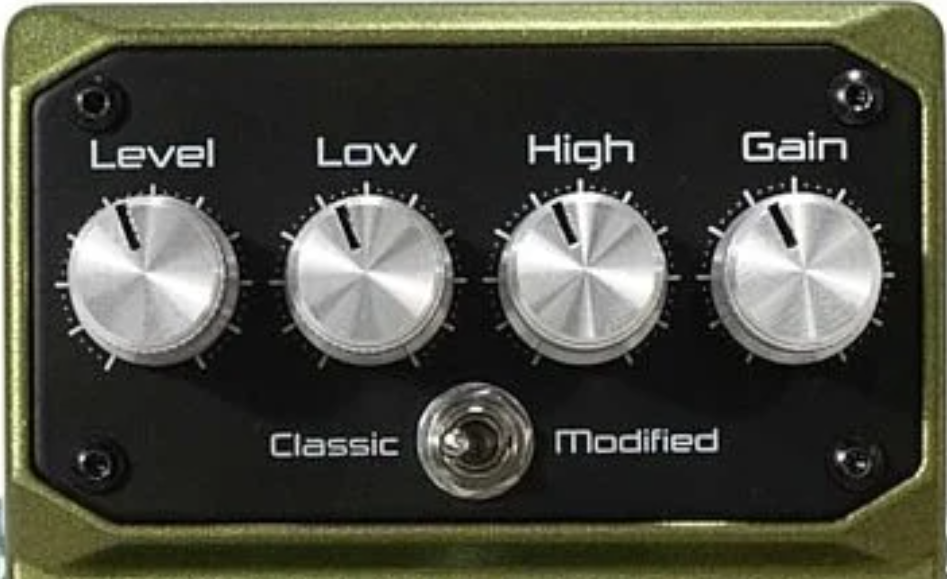
Controls:
- Level: Controls the pedal's output volume. There is enough range here to match the bypassed signal, add a small lift for solos, or hit the front end of an amp harder when the Gain control is kept low.
- Low: Boosts or cuts the bass frequencies. This is one of the controls that separates the CM-2 from a lot of traditional overdrives. You can trim the bottom end to tighten a dark or already overdriven amp, or add body when using a bright clean amp or thinner single-coil pickups.
- High: Boosts or cuts the treble frequencies. It can add bite and definition to a warm rig or smooth the top end when a bright guitar and amp combination starts getting a little sharp.
- Gain: Controls the amount of overdrive. Lower settings work well for clean boosting and edge-of-breakup sounds. Higher settings move into thick blues, classic rock, and crunchy rhythm territory while retaining better note separation than many heavily compressed overdrives.
- Classic/Modified Voicing Switch: Selects between the CM-2's two gain voices. Classic is the more open and articulate setting, with a smoother response and less added low-end weight. Modified adds gain, compression, and a fuller bottom end, giving the pedal a hotter and more aggressive personality.
- The Mystery of Modified Mode
One of the biggest unanswered questions surrounding the HardWire CM-2 is what exactly happens when you flip the switch from Classic to Modified.
On most overdrive pedals, a switch like this simply changes a few component values, clipping diodes, or EQ settings while leaving the rest of the circuit largely untouched. Over the years, however, some players and circuit enthusiasts have suggested that the CM-2 may be doing something much more involved.
DigiTech never publicly explained exactly what the Modified mode was doing internally, so for now the question remains unanswered. What is clear is that Modified mode offers more gain, more low end, and a much less pronounced mid hump than Classic mode. To many players, it feels less like a different setting and more like an entirely different pedal hiding inside the same box.
As new information and documentation are uncovered, this page will continue to be updated. One of the things I enjoy most about preserving the history of these pedals is that there always seems to be another mystery waiting to be solved.
- Footswitch: Activates or bypasses the effect using HardWire's true bypass switching system. The pedal originally included a removable Foot Switch Glow Sticker to make the switch easier to find on a dark stage.

Pricing Breakdown:
- List price: $159.99 (Winter NAMM January 2008)
- Street Price: $99.95 (2008 - 2014)
- Closeout Price: $49.99 (2014 - 2015)
- Average Street Value Today: $75 - $100 (July 2026 - see Collector notes below)

Technical info:
- Power: One 9V alkaline battery or an optional Harman PS200R 9V DC power supply. Published information lists the CM-2 at approximately 25mA current draw and about 17 hours of battery life under typical use.
- Internal Operating Voltage: The HardWire Series used internal voltage-conversion circuitry to operate at approximately 15 volts from a standard 9V battery or supply. That extra operating voltage gives the circuit more headroom and helps the pedal stay clear and composed when it is hit with hotter pickups or a strong boosted signal.
- Specifications: Mono 1/4-inch input and output. Input impedance is approximately 1 MOhm with the effect active. Output impedance is approximately 1 kOhm with the effect active. Published dimensions are approximately 3.5 inches wide, 5.5 inches long, and 2.15 inches high. Weight is approximately 1.3 pounds.
- Signal Path: Analog overdrive circuit with true HardWire bypass. The CM-2 is not a digital amp model or a DSP-based distortion effect.
- EQ Design: Separate active Low and High boost/cut controls provide considerably more flexibility than the single passive tone control found on many traditional overdrive pedals.
- Construction: Heavy cast-metal enclosure with metal jacks, metal control hardware, and the oversized HardWire footswitch and battery-access assembly. Like the rest of the original HardWire line, it was built with regular stage use in mind.
- Included Accessories: Originally shipped with the StompLock™ knob guard, Foot Switch Glow Sticker, hook-and-loop pedalboard pad, owner's manual, and warranty documentation.
- Badge/Footswitch Variations: Three documented combinations; see the CM-2 badge history below.
- Notable IC chip: (Needs further research to verify)
- Component-side circuitboard image: (Coming soon)

(L to R) The original HardWire-footswitch version, the later DigiTech-footswitch version with the Tube Distortion badge,
and the the newly documented combination: DigiTech footswitch with the HardWire CM-2 Tube Overdrive badge.
Overdrive or Distortion? The Real Story Behind The CM-2 Name Change
One of the more confusing chapters in the CM-2 story involves the name printed on the pedal itself. The original version carries the large HardWire name on the
footswitch and is labeled CM-2 Tube Overdrive. The later version places the DigiTech name on the footswitch, retains HardWire CM-2 on the smaller
metal badge, and changes the description to Tube Distortion.
For years, some collectors assumed that "Tube Distortion" was simply a printing mistake. Others believed the name had been changed intentionally as part of the
HardWire rebranding. We can now put at least that part of the debate to rest.
John Hanson, who designed the CM-2 circuit, confirmed directly to AmericasPedals.net that the change was intentional:
"The name change was a marketing decision based on feedback we had received from the field. The circuit didn't change, only the badge."
The surviving documentation supports Hanson's account, but adds to the confusion. Harman didn't rebrand the box, owner's manual, and other product materials to say
"Tube Distortion." They continued identifying the pedal by its original name, CM-2 Tube Overdrive, even when the pedal inside carried the later Tube Distortion
badge. There was no new circuit or separate model designation. The marketing change only happened to the pedal itself.

The later CM-2 Tube Distortion shown with the original box it came in, which retains the HardWire CM-2 Tube Overdrive designation. This confirms that the badge changed
while the packaging did not.
So, we know the name change was intentional and that nothing inside the pedal changed. But why did the DigiTech name suddenly appear on the footswitch? The
answer takes us beyond the CM-2 itself and into a broader corporate rebranding of the entire HardWire line.
That rebranding began in 2012. On the original pedals, HardWire was presented so prominently that it could easily be seen as a separate brand. Harman wanted to bring
the line back under a clearer corporate brand structure, so the DigiTech name was moved to the most visible position on the footswitch. “HardWire CM-2” remained on
the metal badge, preserving HardWire as the product-line identity while making DigiTech the primary brand.
Okay, so the branding change makes sense. What remains unclear is why Harman chose to change “Tube Overdrive” to “Tube Distortion.”
Hanson's statement confirms that the decision came from marketing feedback, but the exact reasoning behind it has not yet been conclusively documented. One explanation
passed along during this research is that distortion pedals were among the strongest-selling effects at the time, while the CM-2 Tube Overdrive had not sold as well as
expected. Changing the name to Tube Distortion may have been an attempt to place the CM-2 in the larger and more popular distortion category.
Another explanation suggests that the CM-2 Tube Distortion, SC-2 Valve Distortion, and TL-2 Metal Distortion were intended to form a more unified three-pedal distortion
lineup. The thinking was that presenting them together could strengthen sales across all three models. That explanation is certainly possible, but firsthand recollections
differ. The HardWire line already had two distortion pedals, and changing the CM-2's name also meant losing the line's only pedal specifically identified as an overdrive.
For that reason, the broader sales strategy remains part of the ongoing investigation. We also do not yet know why the box, manual, and other product materials
were left unchanged. What we can say with confidence is that the badge change was deliberate, it was connected to feedback from the field, and it did not involve any
change to the circuit.
While some of the reasoning behind the name change remains unclear, the badge history has another twist. Three distinct CM-2 footswitch-and-badge combinations have now been documented:
- Original combination: HardWire-logo footswitch with a CM-2 Tube Overdrive badge.
- Later combination: DigiTech-logo footswitch with a HardWire CM-2 Tube Distortion badge.
- Newly documented combination: DigiTech-logo footswitch with a HardWire CM-2 Tube Overdrive badge.
The third combination is documented by the photographed example shown above. The photo confirms that this combination exists, but it does not establish whether it left the factory that way or whether the DigiTech footswitch cover was replaced later. I have not found evidence that the third combination represents a circuit change.
AmericasPedals.net continues to speak with former DigiTech employees involved in the engineering, marketing, and management of the HardWire line. As new firsthand information, photographs, or internal documentation is uncovered, this section will be updated and the story will continue to take shape.
Source: John Hanson, CM-2 circuit designer, personal communication with Ron Henley, July 22, 2026.

Heritage: (HardWire gain family) HardWire SC-2 Valve Distortion  HardWire TL-2 Metal Distortion
How players actually use it:
- As an edge-of-breakup overdrive: Put it in Classic mode, keep the Gain low, and set Level just above unity. This gives a clean amp some hair and makes it respond more like it is being pushed naturally.
- As a boost into an already dirty amp: Lower the Gain, raise the Level, and trim the Low control until the amp tightens up. The independent EQ makes the CM-2 especially useful here because you do not have to accept a preset bass cut or a large midrange hump.
- For a complete blues-rock rhythm sound: Modified mode with the Gain near noon adds enough thickness and sustain to carry the main overdrive sound into a clean or slightly breaking-up amp.
- To fatten single-coil pickups: Add a little Low, keep the High near noon, and use Modified mode at moderate gain. It gives Strat and Tele bridge pickups more body without sanding away all of their attack.
- To keep humbuckers from getting muddy: Back the Low control down slightly and add just enough High to preserve definition. The CM-2 can sound big without turning a neck humbucker into a blanket.
- As an always-on tone shaper: With the Gain nearly off, the Low and High controls can balance a difficult room, a backline amp, or a guitar that needs a little help fitting into the mix.
(Click to enlarge)

Suggested starting settings:
- Clean push: Classic mode, Level around 1 to 2 o'clock, Gain around 8 to 9 o'clock, and both EQ controls at noon. Adjust the Low control first if the amp starts getting loose.
- Open blues rhythm: Classic mode, Level around noon, Gain around 11 o'clock, Low around 1 o'clock, and High around noon. This keeps the response lively and lets your picking hand do most of the work.
- Thick blues-rock lead: Modified mode, Level around 1 o'clock, Gain around 1 to 2 o'clock, Low just past noon, and High around noon. This gives you more sustain and weight without throwing away note definition.
- Tight amp boost: Classic mode, Level around 2 o'clock, Gain nearly off, Low around 10 o'clock, and High around 1 o'clock. Good for pushing a crunchy amp while keeping the bottom end from spreading out.
- Warm classic-rock crunch: Modified mode, Level at noon, Gain around noon, Low around 1 o'clock, and High around 11 o'clock. This works especially well with a bright clean amp.

Collector notes:
- Like the rest of the original HardWire family, the CM-2 originally shipped with the StompLock™ knob guard, Foot Switch Glow Sticker, hook-and-loop pedalboard pad, owner's manual, warranty card, and retail box. Complete examples are naturally more desirable to collectors.
- The CM-2 never developed the cult following of the RV-7 or Supernatural, but that has kept prices surprisingly reasonable. As of July 2026, clean working examples typically sell in the $75 to $100 range, making the CM-2 one of the better bargains in the entire HardWire lineup.
- Because these pedals were bought to be used rather than collected, scratched corners, missing StompLocks, worn labels, and missing box candy are all common. Finding a truly complete example is becoming less common every year.
- When buying used, pay particular attention to the Classic/Modified switch. Both positions should produce an obvious difference in gain structure and low-end response.

Known quirks and tips:
- The Low and High controls are active, so noon is your starting point. Unlike a lot of overdrives, this isn't a "set everything at noon and forget it" pedal. Small adjustments can make a really big difference.
- Modified mode isn't just Classic with more gain. It gets thicker, fuller, and a little louder too, so don't be surprised if you find yourself making a quick Level adjustment when switching between the two modes.
- The CM-2 has no shortage of low end available. That's great with a bright clean amp, but if you're using it to push an already thick amp, don't be afraid to back the Low control down a bit. Sometimes that's all it takes to tighten everything up.
- If the CM-2 isn't hitting the amp as hard as you'd like, try bringing up the Level before piling on more Gain. The CM-2 usually sounds best when the pedal and the amp are working together instead of asking one to do all the heavy lifting.
- Classic mode pairs surprisingly well with humbuckers. The more open response helps chords stay clear and keeps things from turning into a big wall of mush.
- Feed it a good regulated 9V supply and let the internal circuitry do the rest. The CM-2 already generates its own higher internal voltage, so there is no need to run an 18V adapter.

Hear the DigiTech HardWire CM-2 Tube Overdrive in action:
External Links:
Home
America's Pedal
FX-Series
X-Series
D-Series
Artist Series
Performer Series
Hardwire Series
Specialty Pedals
New Releases
Field Guide
Serial Number info
FX literature
What's New?
FX Tech info
Links
Disclaimer/Legal/Contact Us
|