DigiTech HardWire TL-2 Metal Distortion
Home > DigiTech Hardwire Series Pedal Index > DigiTech HardWire TL-2 Metal Distortion

Making its debut at the Anaheim, California Winter NAMM show in January 2008, the DigiTech HardWire TL-2 Metal Distortion is one of those true sleeper pedals
that never seemed to get the attention it deserved. When you start talking about HardWire pedals, most people jump right into the RV-7, Supernatural, or one of the
overdrive models. The TL-2 often gets overlooked, which is a shame because it is one of the most versatile high-gain distortion pedals DigiTech ever built. While it
was clearly aimed at metal players, there is enough tone-shaping power packed into this little jewel that most guitar players would be surprised by how versatile it
really is.

Released as part of DigiTech's revered HardWire Series, the TL-2 came from one of the most interesting periods in the company's history. The HardWire pedals
were built like tanks, looked great, and offered features that guitar players were actually asking for. Another cool thing about the TL-2 is that
DigiTech chose to keep it completely analog while giving players an incredible amount of control over their sound. If you spend a little time playing with the mid
controls and the Tight/Loose switch, you'll discover that this pedal can do a whole lot more than you thought.
Okay, let's melt some faces =)
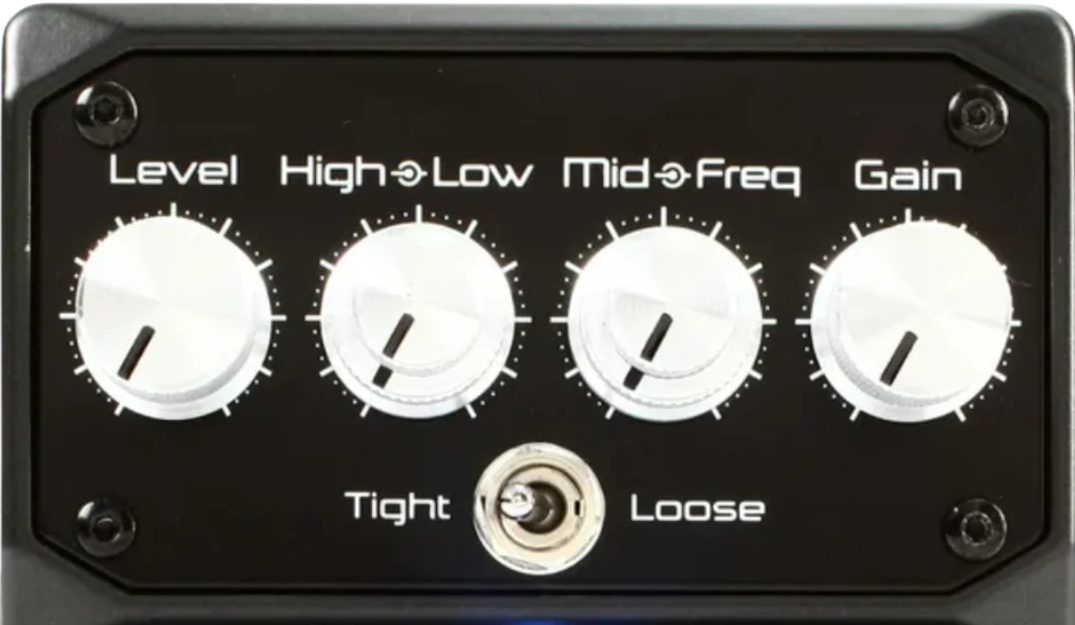
Controls:
- Level: Controls the overall output volume of the pedal. There is plenty of output available here, making it easy to match your bypassed signal or give your amp a little extra push if that's what you're after.
- Gain: If you're buying a pedal called the TL-2 Metal Distortion, chances are this is the knob you'll be reaching for first! The TL-2 has more gain than most players will ever need, but it never feels out of control. At lower settings you can get some really solid hard rock tones, and as you turn it up, it moves into modern metal without turning into a muddy mess.
- Low: Adjusts the bass frequencies. A little goes a long way here. Too much can get a little boomy depending on your amp, but dialed in right, it gives the TL-2 a big, powerful sound without losing definition.
- High: Controls the top end. If your pickups or amp are naturally bright, you can smooth things out here. If your tone needs a little more bite, just turn it up until everything comes alive.
- Mid Freq: This is one of the controls that really separates the TL-2 from a lot of distortion pedals. Instead of being stuck with one fixed midrange, you get to choose exactly where those mids live. That gives you a tremendous amount of control over the overall character of the pedal.
- Mid Level: Once you've found the frequency you like, this control lets you boost it or cut it. Want that classic scooped metal sound? Cut the mids. Need your guitar to stand out in a live mix? Bring them back up. These two controls work together, and once you spend a few minutes with them, you'll realize just how versatile this pedal really is.
- Tight / Loose Switch: I love this switch. Flip it to Tight and everything becomes more focused with a firmer low end that's great for fast rhythm playing and palm muting. Move it over to Loose and the pedal opens up with a bigger, fuller feel that's perfect for slower, heavier riffs. It's almost like having two different distortion pedals sitting in the same box.

Historical Pricing:
- List Price: (Pointing to $149.95 - Needs further research to verify)
The original suggested retail price has proven surprisingly difficult to document. I've searched catalogs, dealer literature, and archived pricing without finding an official published MSRP that I can verify with confidence. As always, I'll continue the research and update this page when solid documentation turns up.
- Original Street Price: $89.95 - $99.95 (2008-2010)
When the TL-2 first appeared at retailers following its Winter NAMM 2008 debut, it typically sold for right around the $100 mark. Considering the build quality, true bypass switching, sweepable mids, and overall versatility, it represented an incredible value compared to many competing high-gain pedals of the day.
- Closeout Price: $69.99 - $89.99 (2011-2015)
Beginning in 2011, retailers started heavily discounting many of the original HardWire-branded pedals as DigiTech transitioned the line to updated branding. Players who picked one up during this period got one of the best bargains in the entire HardWire lineup, and many of those owners still consider the TL-2 one of DigiTech's most underrated distortion pedals.
Wait... These Dates Don't Make Sense.
While researching the TL-2, I found myself going down a rabbit hole trying to answer a question I've heard more than once over the years: "If these pedals were so
good, why did DigiTech discontinue them?" The answer isn't quite as simple as many people think because there were really two different events that happened several
years apart.
The first came in 2011. If you were shopping for guitar gear back then, you probably remember seeing HardWire pedals suddenly selling for prices that seemed almost
too good to be true. Many dealers were blowing them out at steep discounts, which led a lot of players to assume the entire line had been discontinued. That wasn't
actually the case.
Instead, DigiTech used the opportunity to reposition the line. The original HardWire branding was phased out in favor of more prominent DigiTech branding. The HardWire
logo was kept but moved up from being featured on the footswitch to the middle of the pedal. Otherwise, the pedals were identical. The Stomplock™ knob guard,
footswitch glow sticker, and custom-cut Velcro (hook and loop) pad were still included in the box to help preserve the series' "tour-worthy" marketing.

The real end of the HardWire Series didn't arrive until late 2015. By then the guitar pedal market had changed considerably. Smaller enclosures were becoming increasingly
popular, and DigiTech began focusing its attention on a new generation of compact pedals like the Polara, Obscura, Dirty Robot, and Ventura Vibe. As production of the
larger HardWire chassis came to an end, the entire series quietly disappeared.
The TL-2 has one of the more interesting stories in the lineup because it was affected by both of these events. During the 2011 closeout, many players overlooked it
simply because it wore the DigiTech name. At the time, there was still a common misconception that DigiTech equaled digital modeling, even though the TL-2 is a fully
analog distortion pedal with an exceptionally flexible EQ section. A lot of metal players passed it by without ever plugging one in.
Ironically, the aggressive closeout pricing ended up becoming the pedal's biggest marketing campaign. Once players actually bought one and spent some time with it,
word spread quickly. They discovered a distortion pedal that could cover everything from tight, modern rhythm work to huge, thick wall-of-sound tones, all while
offering far more control than many competing high-gain pedals. The Tight/Loose switch, combined with the sweepable midrange controls, gave the TL-2 a level of
flexibility that many players simply weren't expecting.
When the HardWire line finally came to an end in 2015, the TL-2 wasn't replaced by another DigiTech pedal, nor was it reborn under the DOD name. It simply disappeared.
Looking back, that probably helped create the reputation it enjoys today. Players who picked one up during those closeout sales discovered something special, and over
the years, the TL-2 has quietly earned a reputation as one of the real sleeper pedals in DigiTech's history.

Technical info:
- Power: 9 VDC power supply or single 9 volt battery. Published specs list approximately 25mA current draw and about 14 hours of battery life under normal use.
- Specifications: 1/4 inch unbalanced input and output, 500 kOhm input impedance with effect on, 1 kOhm output impedance with effect on, metal chassis, true
bypass switching, and dimensions of approximately 3.5 inches wide, 5.5 inches long, and 2.25 inches high.
- Component Variations: None.
- Notable IC Chip: Nope. There isn't a legendary "secret weapon" chip hiding inside the TL-2. It's a fully analog distortion pedal built with commonly
available analog ICs and carefully voiced circuitry. In this case, the magic isn't one particular component. It's the way DigiTech designed the entire circuit.
One thing I found interesting while researching the HardWire Series is that the entire premium pedal line was engineered around standardized Surface Mount Technology
(SMT) manufacturing and high-voltage internal rails. That meant DigiTech could produce these pedals with remarkable consistency from one production run to the next.
As a result, there are no known "holy grail" circuit revisions or coveted chip variations like collectors sometimes chase in older pedals. If I ever uncover factory
documentation identifying every IC used in the TL-2, I'll be sure to add it here.
- Component-side circuitboard image: I'll crack mine open and snap some good pics =)
Heritage: Short answer? None, at least not directly.
Unlike many DigiTech pedals that can trace their lineage back to a DOD circuit (Bad Monkey → OD250 family, Screamin' Blues → Bluesbreaker-inspired topology, etc.),
the TL-2 appears to have been developed as a new analog design specifically for the HardWire Series.
That, in itself, is worth mentioning. Here's some other things I found to help clear up any confusion and/or misinformation:
It Wasn't Based on Earlier DigiTech or DOD Designs.
A lot of people assume the TL-2 is related to the DOD FX70 Metal X, FX86B Death Metal, FX101 Grind, FX102 Buzz Box, or even the DigiTech Death Metal. It really isn't.
Those pedals were built to deliver one particular style of high-gain distortion. The TL-2 took a completely different approach by giving players far more control over
shaping their sound.
In short, the TL-2 was designed to be sculpted, not just turned up.
The same goes for the DigiTech Metal Master. At first glance, it's easy to assume the TL-2 was simply a dressed-up version of the Metal Master, but that really wasn't
the case. The Metal Master was built as a solid, affordable distortion pedal. The TL-2 was designed from the ground up as part of DigiTech's premium HardWire Series,
giving players much greater control over their sound.
They're both great pedals, but they each have their own personality.

TL-2 shown with the Stomplock™ and Foot Switch Glow Sticker
How players actually use it:
- Modern tight rhythm: Put the voicing switch on Tight, keep the gain in check, and use the mid controls to lock the guitar into the band mix. This is where the TL-2 really earns its name.
- Loose grind: Flip it to Loose when you want more sag, more low-end chew, and a nastier feel under the pick. It gets bigger and less surgical, which can be perfect for doomier riffs or sludgy rhythm work.
- Mid-sculpted leads: The sweepable mids are not just for rhythm players. Push the mid level, move the frequency until the guitar jumps forward, and the TL-2 can produce a thick lead voice that does not disappear when the band kicks in.
- Into a clean amp: This pedal can carry a lot of the gain structure on its own, so it works surprisingly well into a clean or edge-of-clean amp. That is one of the reasons it became a sleeper favorite for players who did not have a high-gain amp sitting around.
- As a recording tool: The EQ range makes it useful when layering guitar tracks. You can make one side tighter and more focused, then make another side a little looser and wider without reaching for a completely different pedal.

Suggested starting settings:
- Tight modern rhythm: Level at unity, Gain around 1 to 2 o'clock, Low around noon, High around noon, Mid Level slightly boosted, Mid Frequency adjusted until the palm mutes stay clear, and the switch set to Tight.
- Thicker old-school grind: Level to taste, Gain around 2 o'clock, Low slightly above noon, High backed off a hair, Mid Level around noon, Mid Frequency lower than center, and the switch set to Loose.
- Cutting lead tone: Level slightly above unity, Gain around 1 o'clock, Low just under noon, High around 1 o'clock, Mid Level boosted, Mid Frequency swept until the notes sing, and Tight or Loose depending on how stiff you want the feel.
- Bedroom riff machine: Gain higher than you probably need, Low around noon, High below noon if the amp is bright, Mid Level boosted just enough to keep the tone from vanishing, and the switch set wherever it makes you grin the most.

Collector notes:
- Three main things collectors look for:
- The Footswitch Plate Logo (HardWire logo vs DigiTech logo)
- Country of Manufacture (USA vs. China)
- Outer Enclosure Finish (Matte Satin vs. Gloss Clear)
- Clean TL-2 pedals are still fairly easy to find compared to some of the more exotic HardWire models, but boxed examples with the manual, knob guard, and original extras are becoming more interesting to collectors.
- The HardWire series has gained respect over time because players finally realized these were not throwaway pedals. The build quality is excellent, and the TL-2 feels like a proper working musician's pedal.
- Used pricing can move around depending on condition, completeness, and whether sellers understand what they have. The phrase "sleeper gem" gets tossed around a lot, but on this one it actually fits.
- The TL-2 is worth watching because it represents DigiTech doing analog high-gain in a serious package at a time when many people were mainly associating the brand with digital modeling and multi-effects.
- Pedals with heavy cosmetic wear are common because these were meant to be used, not babied. That does not scare me off at all if the pedal is working properly.

Known quirks and tips:
- The EQ is powerful enough to get you in trouble. Small moves on the mid controls can make a big difference, so do not judge the pedal from one random setting.
- If the pedal sounds fizzy, back down the High control before blaming the pedal. A bright amp, fresh strings, and too much top end can make any metal distortion sound like angry bees in a coffee can.
- The Tight/Loose switch is more than a minor flavor change. Treat it like choosing the basic feel of the pedal before you start fine-tuning the knobs.
- The rubberized footswitch pad and heavy enclosure make it feel very different from older DigiTech pedals. That rugged feel is a big part of the HardWire identity.
- Like many high-gain pedals, it gets along best with a good power supply. Noise goes up fast when you stack gain on top of gain, so clean power matters.
Hear the DigiTech HardWire TL-2 Metal Distortion in action:
External Links:
Home  America's Pedal
FX-Series
X-Series
D-Series
Artist Series
Performer Series
Hardwire Series
Specialty Pedals
New Releases
Field Guide
Serial Number info
FX literature
What's New?
FX Tech info
Links
Disclaimer/Legal/Contact Us
|